
|
Special Effects (F/X) - Milestones in Film 1970-1974 |
|
|
|
|||||||
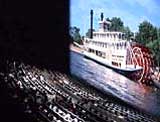
Tiger Child (1970) There were up to nine simultaneously-viewed images within the frame.
|
|
|||||||
|
The Andromeda Strain (1971) This film contained possibly the first use of computer rendering (in the mapped view of the rotating 2-D structure of the massive, hi-tech, top secret 5-story, cylindrical underground laboratory in the Nevada desert named Project Wildfire). Biologist Dr. Jeremy Stone (Arthur Hill) turned on the 'animated' computer simulation of the "electronic diagram which rotates to afford an overall view, or it can be stopped at any section. Detailed plans of the various levels and labs are also stored in the system...." |
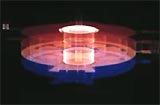 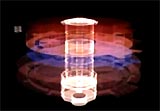 Rotating 2-D Structure - A Computer Rendering |
||||||
|
A
Clockwork Orange (1971, UK) |
|||||||
|
Fritz the Cat (1972) It was also the first independent animated film to gross more than $100 million at the box office. |
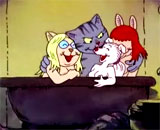 X-rated Fritz the Cat Animation |
||||||
  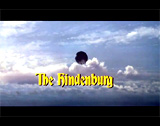 |
The Poseidon Adventure (1972), Earthquake (1974) and The Hindenburg (1975)
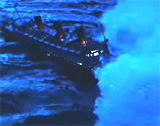
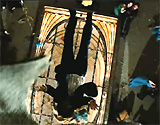
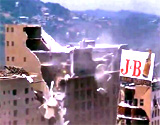
The Poseidon Adventure (1972) opened during a New Year Eve's Party on board the SS Poseidon on its final journey from New York to Athens, Greece. A gigantic 90 foot wall of water (a rogue wave), caused by a 7.8 sub-ocean earthquake, flipped the ocean liner upside down. The exterior shot of the capsizing was created with a large miniature model in an enormous water tank on the 20th Century Fox back lot. One of the most unforgettable images was of passengers hanging onto upside down tables, and then falling to their deaths - into ceilings. The special effects of Earthquake (1974) included 'model' skyscrapers that collapsed, panoramic views of Los Angeles (matte paintings), Styrofoam concrete, and a 'miniature' to depict the crumbling Hollywood Dam. Earthquake's sole competitive Academy Award Oscar win was for Best Sound, involving the Sensurround audio system.
In The Hindenburg (1974), the events surrounding the sabotage (fictional) and eventual destruction of the Nazi's German zeppelin dubbed the Hindenburg were highlighted. The climax of the film was the massive explosion and fire that downed the flying airship as it arrived at the Lakehurst Naval Air Station in New York on May 6, 1937 - simulated or manufactured footage and historical footage were composited together. Over 70 matte paintings and multi-element complex blue screen composites, plus miniatures and a large-scale model (over 25 feet in length) of the dirigible were created. |
  The Poseidon Adventure (1972) 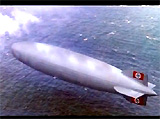 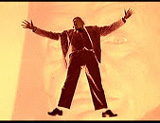 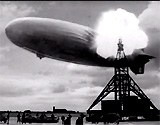 The Hindenburg (1975) |
||||||
|
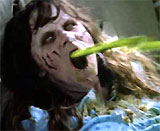
This sensational, shocking horror story about devil possession and the subsequent exorcism of the demonic spirits from a young, innocent girl (of a divorced family) (Linda Blair) contained some highly memorable scenes, using various special effects techniques. There were some truly nauseating, horrendous special effects including the 360 degree head-rotation, self-mutilation/masturbation with a crucifix, and the projectile spewing of green puke - a mixture of split-pea soup and oatmeal through a nozzle attached to the stunt double's mouth, etc.
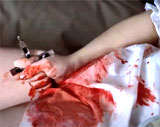
In the scene in which the words: "help me" appeared on the girl's stomach, the welts were produced on a foam rubber stomach by applying a strong chemical. The shrinking of the swelling by heat guns was filmed - and then projected in reverse - to make it appear like the words were rising up through the skin. |
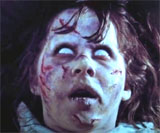 Demonic Eye-Rolling 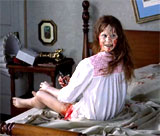 180 Degree Head Rotation 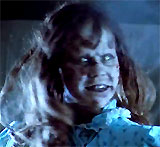 360 Degree Spinning Head |
||||||
|
Soylent Green (1973) In this sci-fi, dystopian thriller, live-in lover Shirl (Leigh Taylor-Young), colloquially known as "furniture," was briefly seen playing the coin-operated video arcade game Computer Space housed in a white unit or fiberglass cabinet. She laughed playfully over the present of the "toy" and was told by rich magnate William Simonson (Joseph Cotten) of the Soylent Corporation:
|
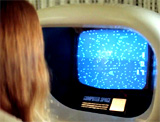 'Computer Space' Videogame - A Futuristic Entertainment Device |
||||||

|
Westworld (1973) Full-screen raster (or bit-mapped) graphics were used in this film by computer graphics artists (at Evans and Sutherland) to produce the scenes representing the android Gunslinger (Yul Brynner) robot's infrared point-of-view or perspective (POV) -- pixelated robovision. Each frame of footage was color-separated and scanned, then converted into rectangular blocks. Color was added to make a coarse pixel matrix that could be output back to film. The first use of 3-D CGI in a feature film was Westworld's sequel, Futureworld (1976). |
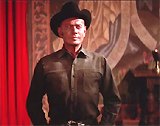 Gunslinger (Yul Brynner) 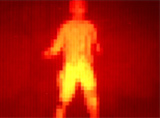 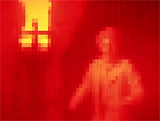 Gunslinger's Infrared POV |
||||||
|
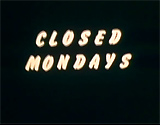
Closed Mondays (1974)
The short was the first instance of Claymation animation, using 3-D clay figures filmed with stop-motion animation. It told of a drunken visitor viewing how objects displayed in an art museum ("Closed Mondays") came to life - and concluded with a twist - the bulbous-nosed visitor was part of the museum's statuary. In the last image, the man was viewed as a stationary
figure on the floor of the museum, seen through an outer window. |
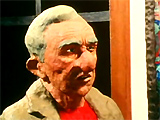 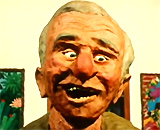 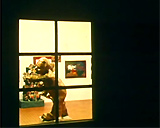
Claymation Stop-Motion Animation |
||||||
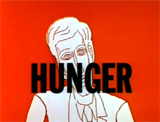
|
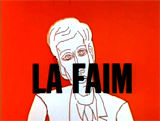
Hunger (1974, Canada) (aka La Faim) Hunger was the first computer-animated film to be nominated for an Academy Award in the Best Short Film (Animated) category. It also won the Jury Prize at the Cannes Film Festival that same year. This surrealistic, avante-garde animated film short (11 minutes long) without dialogue from the National Film Board of Canada (and director Peter Foldes) was the first to use computer digitization to interpolate (or 'fill in') the animated action between various key cells drawn free-hand, although it had experimentally been demonstrated with his earlier film, Metadata (1971). The film's director was the first animator to use computer animation (a computer-assisted 'key-frame animation' system) that imitated conventional cel animation. Black and white animated illustrations appeared against a colored backdrop, with surrealistic figures that fluidly and rapidly dissolved and reshaped themselves to take new forms - an early and primitive example of morphing. |
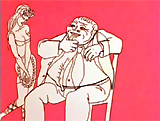 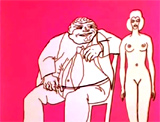 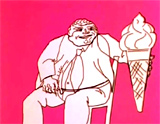
|
||||||




 All
three of these films won the Special Achievement Award for Visual Effects,
during the 70s era of
All
three of these films won the Special Achievement Award for Visual Effects,
during the 70s era of 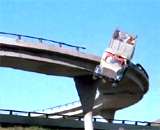
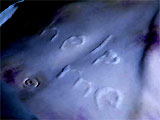 Raised Welts: "Help me"