|
Special Effects (F/X) - Milestones in Film 1989-1991 |
|
The Abyss (1989)
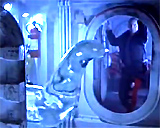
It employed both revolutionary, never-before-seen techniques and traditional visual-special effects (including miniature models, matte paintings, rear projection, and stop motion). For example, both real submersibles and quarter-scale miniaturized radio-controlled submarines were employed, in combination with other effects. In some cases, to simulate the actors inside the submersible (from a POV outside the pod), a small backlit projector screen was rigged up inside the miniaturized models to play pre-recorded footage of the actors. In summary, these were the traditional effects mostly used:
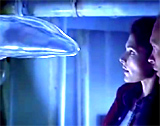
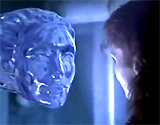
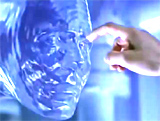
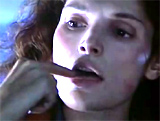
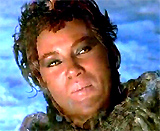
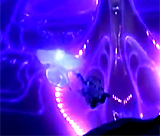
The story told about the crew of an experimental underwater oil drilling platform, led by Virgil "Bud" Brigman (Ed Harris) and a team of Navy SEAL divers led by Lt. Coffey (Michael Biehn) who were investigating the sinking of a US submarine in the Caribbean. One of the best action submersible chase sequences involved Virgil and his wife Lindsey (Mary Elizabeth Mastrantonio) pursuing deranged Lt. Coffey as he attempted to set off a nuclear weapon at the bottom of the Cayman Trench to eliminate the extra-terrestrials. In another part of the film was the crowning milestone achievement of F/X - an encounter with the underwater-dwelling aliens. Visual effects, especially of the watery, snake-like alien creature, a 'pseudopod,' represented the first example of digitally-animated, CGI water. This was the first computer generated three-dimensional (3-D) character - real cutting-edge technology. The film exhibited seamless and convincing compositing of 3-D animation together with 70 mm live-action footage.
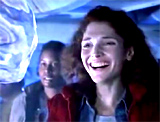
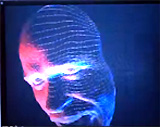
In the alien water-probe sequence lasting about 75 seconds (requiring 8 months of work), the water-based life form called a water pseudopod, with a realistic CG watery tentacle or vertical column of water, replicated (or emulated) facial expressions and appeared to communicate by movements that resembled the humans' facial expressions. Lindsey also touched the virtual creature with her hand, and tasted the substance on her finger, pronouncing it: "Sea water." For the mimicking shots, the two actors had their faces captured by a Cyberware scanner - a device that circled their faces and bombarded them with laser beams to map their 3D geometry. [Note: 3D scanners of this type were earlier used to morph the heads of the Enterprise crew in Star Trek IV: The Voyage Home (1986).]
|
 Underwater Scene |
|||||||||||||||||||||
|
Back to the Future, Part II (1989) Director Robert Zemeckis' comedy sci-fi sequel, besides impressive f/x camera work and effects, also was predictive of future inventions or trends for the year 2015 - some of which were not very accurate:
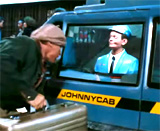
Computer-controlled camera work, called VistaGlide, allowed three characters (all performed by one actor, Michael J. Fox) to match up and interact seamlessly in the same scene (the dehydrated "instant pizza" dinner scene), through impressive split-screen photography. Fox played three characters (Marty Sr., Marty Jr., and Marlene) in the same scene, with a moving boundary between the three sections of the split-screen. It was the first film to accomplish interaction between the same actor on the screen as more than one character. Another special F/X sequence was the airborne hoverboard chase scene -- the hoverboards were fictional futuristic skateboards without wheels -- merely special F/X creations. Actors (standing on glued-on or attached hoverboards) were held up in the air by a rig on the back of a truck and driven around - pulled on wires (later digitally removed), making them appear to be floating and sailing in mid-air. In some scenes requiring closeups, the action was filmed in front of a bluescreen, to later be filled in with matching background footage.
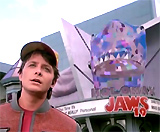
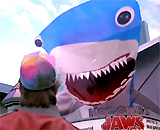
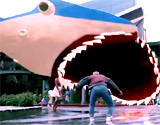
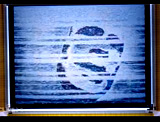
There was a brief sequence of CGI in a holographic shark used to promote a fictional Jaws 19 playing at a theatre - that threatened to chew into Marty - an example of personal targeted advertising. |
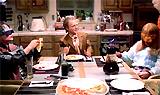 Hydrated Pizza Dinner Scene 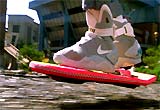 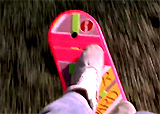 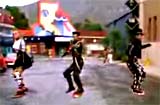 The Hoverboard Sequence 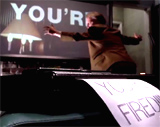 Videoscreen and Dot-Matrix Printer |
|||||||||||||||||||||
|
Indiana Jones and the Last Crusade (1989) The third installment of the Indiana Jones franchise was about the late 1930s search for the authentic Holy Grail, in competition with the Nazis, to attain its life giving properties. The first all-digital composite shot, to demonstrate rapid aging (and death), was during Nazi sympathizer Walter Donovan's (Julian Glover) death sequence in the film's conclusion. It was learned that the immortal Grail guardian Knight (Robert Eddison) had hidden the real sacred Grail among lots of other glittering cups. The Knight advised Donovan: "Choose wisely." Dr. Elsa Schneider (Alison Doody) chose what she believed was the true Grail - a solid gold, emerald-encrusted goblet. She tricked Donovan into drinking from this false Holy Grail cup. He drank and then realized something was wrong ("What is happening to me?"). The Knight calmly observed that it was the wrong cup: "He chose...poorly." His hair suddenly sprouted, and he quickly perished from immediate decomposition when his body aged rapidly. His skeletal remains shattered and disintegrated into dust. The effect was accomplished by filming different images of the actor's make-up applied from beginning to end. ILM scanned the several filmed makeup transformations of his facial demise and "morphed" the multiple scanned film elements together digitally - it sent the output back to film (with a laser) rather than arranging film elements with an optical printer. |
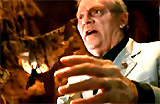 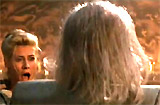 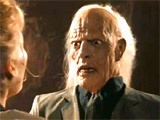 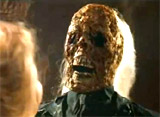 The First All-Digital Composite Shot  Disintegrated to Dust |
|||||||||||||||||||||

|
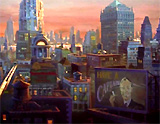
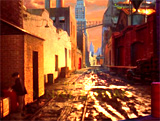
Dick Tracy (1990) This visually-rich action comedy was based on Chester Gould's 1930s comic strip character of the same name, portrayed by actor Warren Beatty. Although its visual-special effects were unique, well-executed, visionary and fresh, it was not nominated for a Visual Effects Oscar, in a year when Total Recall (1990) was given the award. It was the first major feature film release with a digital audio soundtrack (Danny Elfman's film score). Dick Tracy (1990) turned out to be a small-scale hit - the budget was reported to have topped $100 million (for marketing, production, and promotional costs), and its revenue was respectable (domestic gross of $103.7 million, and worldwide $162.7 million), and it also made money on home video. It was the 9th highest-grossing film of its year. However, Disney was disappointed with the overall results - hoping that it would be a bigger box-office success that would lead to a larger franchise. The film was remarkable in that it was entirely shot on backlots and sound stages (not on-location). Traditional special effects techniques were used, such as miniature models and hand-painted matte drawings (usually of backdrops, backgrounds of scenes, or urban skylines and cityscapes) that were afterwards optically integrated with the live action. The matte paintings were very much in evidence during the opening and closing credit sequences when the camera panned up and across TracyTown past smoking smokestacks and foreground structures. It was reported that there were 60 matte shots in the entire film.
It was one of the last major films to include no computer-graphics. In future years, commonly-used CGI would create immersive backgrounds more easily. The impressionistic effects were to create the illusion that the viewer had entered a comic-strip world. And in addition, to approximate the comic-viewing experience, the story was told mostly in vignettes - without a moving camera. It was director Warren Beatty’s decision to limit the film’s designers to a very small number of colors in its palette. Only the seven colors cartoonist Chester Gould had used in his original Dick Tracy drawings were to be employed. The production design (Oscar-winning for Art Direction, one of three wins from seven nominations) was entirely of those brilliant solid colors (from the original strip): red, green, purple, yellow, and orange, plus black and white, to create a garish fantasy world of clothing, cars and buildings. |
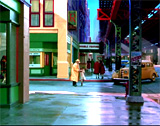 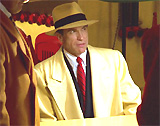 Tracy With a Yellow Overcoat and Fedora 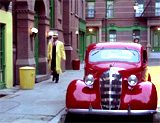 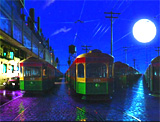 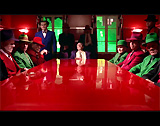 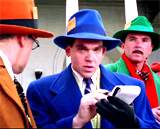 |
|||||||||||||||||||||
|
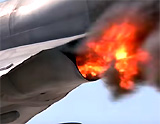
Director Renny Harlin's action film was the second in the long-running film franchise. Its story, set on Christmas Eve in 1990, revolved around series star, police detective John McClane (Bruce Willis), who was at Dulles International Airport in Washington DC, awaiting the arrival of his wife Holly's (Bonnie Bedalia) plane from Los Angeles. He witnessed how rogue, ex-Special Forces terrorists, led by Colonel Stuart (William Sadler), infiltrated the airport, took over ATC (air traffic control) and threatened all incoming planes. At the same time, deposed and extradited drug-lord President General Esperanza (Franco Nero) from Valverde (fictional) in South America was arriving to be handed over to American authorities and tried for drug trafficking. At about the 75 minute mark in the film in the scene after dictator Esperanza's plane landed, gunfire erupted as Stuart and his men arrived to pick up Esperanza. McClane was able to wound the dictator in the shoulder. He became trapped in the cockpit, which became riddled by bullets. When grenades were thrown into the cockpit through smashed windows, McClane ejected himself and parachuted to safety, as fire trucks arrived. [Note: There were two factual problems - grenades have 6-second fuses, not 30 seconds, and cargo planes are not equipped with ejector seats.] This particular scene contained extensive blue screen compositing as McClane ejected himself out of the exploding military plane's cockpit filled with grenades. The final shot of the film (a pull-back shot as the end credits were displayed) was a wide panoramic view of the airport with people, planes, and vehicles - it was a digital matte painting. It marked the first instance of a film using a traditional glass matte painting (created at ILM) that had been photographed and scanned into a computer, and then digitally-composited or manipulated with elements of live-action footage. Glass matte painting has now been superseded by digital images created using photo references, 3-D models, and drawing tablets. The digitally matte painted textures are combined within computer-generated 3-D environments, easily allowing for 3-D camera movement. |
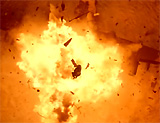 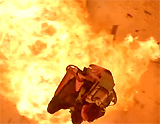 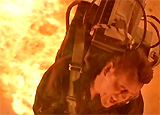 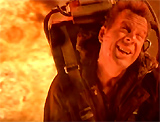 McClane's Cockpit Ejection With Blue-Screen Compositing 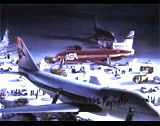 Film's End Shot - Digital Matte Painting |
|||||||||||||||||||||

|
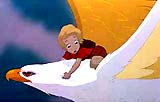
The Rescuers Down Under (1990) Disney's The Rescuers Down Under (1990), the sequel to their hit The Rescuers (1977), was the studio's very first, theatrically-released animated sequel. However, it performed very poorly at the box-office due to its disastrous, head-to-head debut competition against the smash hit Home Alone (1990). The visually-sophisticated animation was noteworthy for two other milestones.
The CAPS system would achieve more fluid-looking, dynamic and complex shots, provide a sense of depth, and update Disney's age-old multi-plane camera. The revolutionary CAPS process completely eliminated hand-inking and hand-coloring. And zoom effects and live-action tracking shots could now be created - for instance, in the film's opening rack-focus sequence when the camera zipped across a field of flowers. And from now on, multi-plane shots didn't require a multi-plane camera. Another spectacular sequence in the film was the one in which Miss Bianca (voice of Eva Gabor) and Bernard (voice of Bob Newhart) desperately ran on spinning deep tread tires.
To its immense credit, The Rescuers Down Under (1990) paved the way for other acclaimed sequences in future Disney feature animations, such as the ballroom scene in Beauty and the Beast (1991) and the wildebeest stampede in The Lion King (1994) (and its own opening rack-focus sequence). |
   Opening Title Credits: The Rack-Focus Sequence |
|||||||||||||||||||||
|
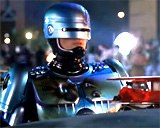
RoboCop 2 (1990) This feature film sequel from director Irvin Kershner (his last film) was set in the futuristic, dystopian urban location of Detroit, Michigan (although filming was mostly in Houston, Texas), and was a continuation of the story about a superhuman cyborg law enforcer called RoboCop - a futuristic cyborg created from the biological remains of slain Detroit police officer, Alex Murphy. The featured tagline was:
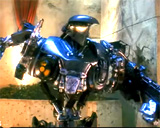
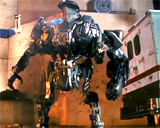
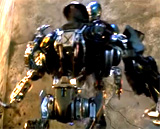
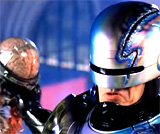
Its most memorable and menacing creature was a cyborg representing the drug-dealing, psychopathic cult leader/villain Cain with a Messiah complex. It was a major special effect character in the film - the Cain cyborg was designed and co-created by legendary special-effects animator Phil Tippett, with many different versions used during the film:
Eight separate animation units worked for nearly four months to complete the project. The finale of the action-crime film came during a violent showdown and confrontation between the film's two cyborgs:
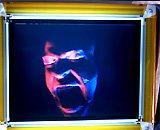
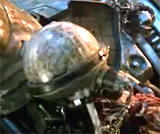
From a high vantage point, RoboCop jumped onto Cain's back so that he could disengage the cyborg's brain center. After a long wrestling struggle, RoboCop finally penetrated the chamber holding the organic remains of Cain's drug-crazed brain. He ripped the fleshy brain out and held it to examine it. At that very moment, a CG representation or version of Cain's face was seen on the robot's monitor screen mounted on his head.
The fight ended when RoboCop smashed the brain onto the pavement, after bidding Cain "Goodbye." When the organic brain was then pummeled by RoboCop's fist, Cain's face reacted in pain - and then the transmission went dead. The lobotomized monster sparked and fell to the ground in a heap of metal. The scene demonstrated the first use of real-time computer graphics or "digital puppetry" in the creation of a character's face. The facial movements were manipulated by a computer operator or puppeteer, in real-time, rather than using pre-programmed commands. Therefore, the special effect involved a combination of real-time digital puppeteering and stop-motion.
|
|
|||||||||||||||||||||
|
Total Recall (1990)
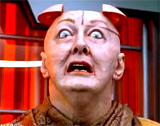
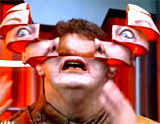
In the complex plot set in the year 2084, construction worker Douglas Quaid (Schwarzenegger) was happily married with his wife Lori (Sharon Stone). Persistent dreams/nightmares about the planet Mars instigated a visit to Rekall, Inc. that promised a 2-week vacation trip to Mars through memory implants. After Quaid chose to travel as a "secret agent" character, the procedure went awry when the Rekall implant began to conflict with Quaid's actual repressed memories of his past when he WAS a secret agent on Mars named Hauser, and working for a mysterious Agency led by evil Vilos Cohaagen (Ronny Cox). An actual trip to Mars was required for Quaid's self-discovery -- to figure out the conspiracy against him, connect with the rebels led by a mutant leader, and destroy Cohaagen's empire (that was involved in the dangerous mining of turbinium ore). It was one of the last films to heavily use miniature effects and one of the first to employ computer-generated imagery (CGI). It was praised for many of its elements, shortly before the almost-complete takeover of visual effects by computers:
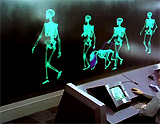
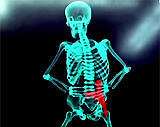
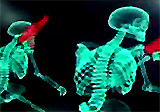
One of the main scenes with special effects was the underground train station shootout sequence, in which passengers walked through a giant X-ray machine about 20 feet in length. However, the first effort to fully computer-animate the skeleton characters through motion-capture failed. Then, it succeeded by rotoscoping the film (shot in low light) and using keyframes - and making use of the live-action, on-set filmed sequences as reference to match the motion. It was later combined optically with the live-action footage.
Other stunning visual effects sequences or characters included:
|
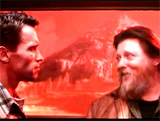 Rear Projection and Front Live-Action Projection 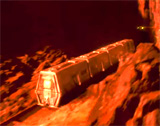 Miniatures - Train on Mars 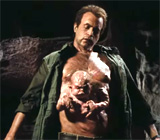 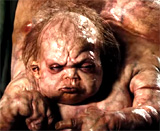 Mutant Kuato - An Animatronic Puppet 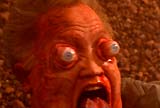 Asphyxiation Death of Vilos Cohaagen (Ronny Cox) on Mars - Puppetry 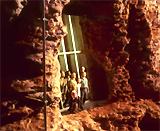 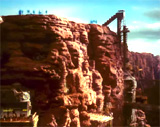 Massive Pull-back Scene of Mutants in Mars Colony (Within Canyon) Viewing New Atmosphere 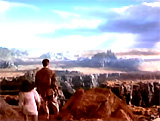 Views of Mars - The Blending Of Live-Action, Miniatures and Matte Paintings |
|||||||||||||||||||||
|
Tremors (1990) This was a classic monster film about threatening, subterranean worm-like creatures in the Nevada desert - a variation on the Jaws movies, and inspired by similar underground worm-predators in David Lynch's Dune (1984) based upon Frank Herbert's novel. Its success spawned a seven-film franchise (direct to video) over three decades, a TV series (13 episodes during the 2003 season) and an ultimately-cancelled SyFy Channel TV-movie reboot in 2018 (although the pilot episode was shot):
Just before the CGI era was fully initiated, this marked the end of creature features with life-sized models and/or puppets. The special effects company Amalgamated Dynamics, before it became well-known, was called upon to create an animatronic full-scale creature model. The graboid's body was built with light-weight foam or rubber, and included three mechanical, full-length, state-of-the-art tentacles.
A full-sized underground graboid monster (a giant, phallic-shaped, carnivorous worm) was not revealed in the film until the characters also saw it. |
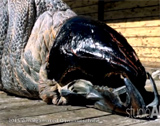 The Full-Scale Model of the Graboid 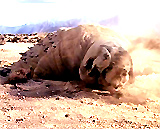 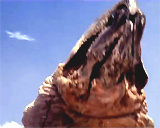 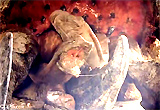 Underground Graboid Monster Revealed |
|||||||||||||||||||||

|
Backdraft (1991) This dramatic thriller film from director Ron Howard about Chicago firefighters featured the first use of photorealistic CG fire in a motion picture (from ILM), to enhance the actual flaming fires (in about 95% of the film). In the final product, miniatures, matte paintings, and live action elements were combined to create the ubiquitous images of burning, collapsing structures. It received three Academy Award nominations for Visual Effects, Best Sound and Sound Effects Editing, but lost in all categories. Although the film was praised for its special effects, its plot was severely criticized as lightweight and inconsequential (due possibly to numerous script rewrites). Backdraft (1991) was the highest grossing film about firefighters (at $152.4 million worldwide revenue) until it was surpassed by I Now Pronounce You Chuck and Larry (2007) (at $187.1 million worldwide) - about two straight, single Brooklyn firefighters who pretended, for financial reasons, to be a gay couple. The fire became an integral character in the film - and in some unrealistic instances, the fire itself transformed into a mysterious, villainous and lifelike character (and was regarded as a "beast" or "animal"). Most of the materials for the fires were provided by Hollywood’s Special Effects Unlimited Inc. According to financial records, the effects to create the fire required a budget of $1.25 million and took four teams to create -- from researching the materials to lighting and controlling the fires on the set. The Chicago Fire Department was integrally involved, helping actors prepare for the roles, standing by on the set at all times for safety's sake, and providing advice on creating realism. The fire was mostly composed of real flammable substances - created from a mix of ignited alcohol, kerosene, diesel fuel, and propane. Steel tanks were built to spray the liquids through a "flame-thrower-like" nozzle before igniting them four or five feet from the machine. Almost the entire film was shot on-location in Chicago, with only a small percentage shot on set. One issue in the film was that most real fires create a lot of intense and thick smoke - something that would impair visibility for the filmed product, so a white, haze-like effect was created to give the impression of smoke without blocking the camera’s view. Another technique was to devise an "ash-o-matic" device to simulate burning ash floating through the air. It spewed smoke and burning bits of cardboard into the air to simulate the swirling ash of a real fire. In a few tricky scenes, aided by George Lucas' ILM division, the actors were superimposed over images of flames that had been filmed separately. Another notable scene inverted the set by turning a room upside down, so that the flame appeared to be burning on the ceiling. |
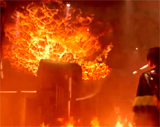 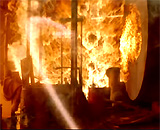 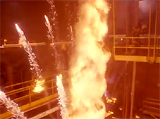 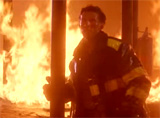 Special Effects - Realistic Fire 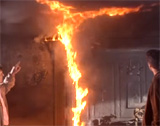 Fire Burning Across Ceiling |
|||||||||||||||||||||

|
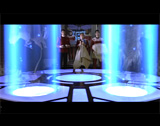
Beauty and the Beast (1991) Beauty and the Beast (1991) was the first full-length animated film to be nominated for Best Picture by the Academy of Motion Pictures Arts and Sciences. It was based on the fairy tale La Belle et la Bête by Jeanne-Marie Leprince de Beaumont. The definitive live-action version of the story was director Jean Cocteau's Beauty and the Beast (1946). It was noted for its major new direction for film effects -- the integration of traditionally hand-drawn cels and computer-generated animation, especially in the ballroom scene in which Belle and the Beast danced. It was the first film in which traditionally hand-drawn characters appeared in a 3D background. Every frame of the film was scanned, created, or composited within Disney's computer animation production system (CAPS) co-developed with Pixar. Computers were used to assist in adding colors and shadows to create 3-D like images within a completely 3-D rendered background, and to simulate complex movements (by tweening motion between frames) in 3-D space.
|
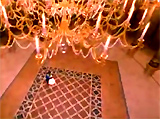 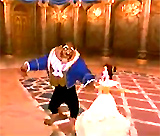 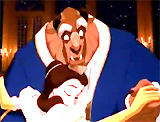 The Ballroom Sequence 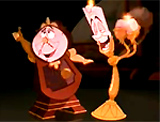 Animated Characters |
|||||||||||||||||||||
|
Flight of the Intruder (1991) Director John Milius' jingoistic, action war-drama (his final theatrical film) was set during the Vietnam War era. At the time, it was made with the complete cooperation of the US Navy. The buddy war film was considered a 'Top Gun' or 'Platoon' clone or re-enactment, with its many Navy aerial bombing missions and combat sequences. Without the use of CGI for the most part, the military film used models and optical film compositing for most of its impressive, low-budget special effects. There were over 30 software-created shots of photo-realistic aircraft, cluster bombs, and smoke in full daylight. Due in part to the timing of its release, during the height of the actual ground war in Kuwait during Operation Desert Storm in 1991, the film suffered at the box-office. The film was set aboard the USS Independence aircraft carrier in the South China Sea in 1972 during the unpopular Vietnam War, where American pilots were flying the Navy's carrier-based, bomber-fighter jet - a Grumman A-6A (nicknamed the Intruder). The main heroic, cynical, anti-authoritarian character was hot shot flyer Lt. Jake' Cool Hand' Grafton (Brad Johnson) who sought payback revenge against N. Vietnam for the death of his bombardier partner Lt. Morgan "Morg" McPherson (Christopher Rich), and others who had died in the senseless war. "Morg" died (shot in the neck) as the result of a Viet sniper-peasant firing his rifle at the A6 Intruder aircraft. The discharge from the gun was added later via rotoscoping. Grafton then partnered with his new bombardier - veteran Lt. Cmdr. Virgil Cole (Willem Dafoe) on his third tour of duty, in plotting to fly an illegal, unauthorized or unsanctioned mission into Hanoi. Their independent and semi-suicidal aerial assault targeted a restricted area using a low elevation bomber without defensive weapons. The special effects crew created a miniature 1:160 scale model of the city of Hanoi for the bombing mission "downtown" behind enemy lines, where the pilots took out their target - "Sam City" (a surface-to-air anti-aircraft missile depot). The city served as the backdrop (via rear projection) for the aerial attack.
|
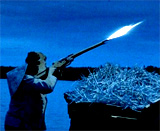 Death of "Morg" by Rifle Fire 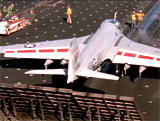 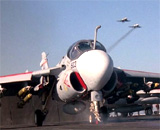 A-GA Intruder Preparations on Aircraft Carrier 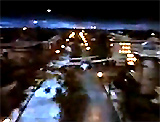 Simulation of Bombing Mission Over Scale Model of Hanoi City |
|||||||||||||||||||||
|
Star Trek VI: The Undiscovered Country (1991) In this sixth film (and the last film in the original series) in the popular Star Trek franchise, Industrial Light & Magic (ILM) did most of the visual effects work, that was ultimately comprised of 51 effects shots. However, the phaser beam and transporter special effects were created by ILM's offshoot - Visual Concepts Engineering.
There were a number of sequences that required extensive visual effects:
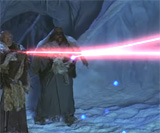
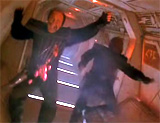
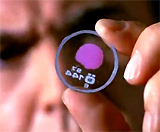
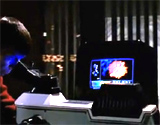
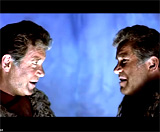
After a brief and unfair Klingon trial for murder, the accused Captain James T. Kirk (William Shatner) and Dr. Leonard McCoy (DeForest Kelley) were sentenced to life imprisonment on the ice-cold, snowy penal asteroid of Rura Penthe (the "Aliens' Graveyard"), to perform hard-labor in the prison camp's dilithium mines. Meanwhile onboard the Enterprise, Spock (Leonard Nimoy) and Vulcanian trainee Lt. Valeris (Kim Cattrall) investigated and tried to find the real killers. They found drops of Klingon purple blood from the shootings on uniforms of the two paid Federation assassins. The film featured a CG view of zero-gravity, and Klingon blood (a purple color) that spurted out of the Klingons' wounds - a sample was magnified on a monitor from a microscopic view.
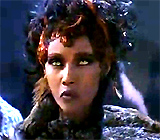
Back on Rura Penthe, Kirk and Dr. McCoy were befriended by shape-changing, yellow-eyed, alien chameloid criminal-prisoner Martia (Iman), who promised to help them escape, but in reality was planning to kill the two and make it look accidental. Computer-generated digital morphing technology was extensively used during the sequence. During their actual escape, Martia morphed from a hulking, hirsute "Brute" male alien (Tom Morga) into a little blonde child (Katie Jane Johnston) to escape her chains and neck restraint. She then changed back into the "Brute" character, and was seated, dressed in a dark brown fur outfit (complete with scarf and a thick outer coat). As she was morphing from the "Brute" to her normal female self, she told Captain Kirk: "Give a girl a chance, Captain. It takes a lot of effort." Kirk immediately suspected that she was leading them into a trap, and she admitted that she was - and would be compensated with a "full pardon." To create an imposter and confuse them, Martia morphed into Kirk himself, culminating in a fist-fight between the two. At the conclusion of their fight, Kirk's double was killed by prison guards to silence her. Shortly later, Kirk and McCoy were rescued when beamed aboard the Enterprise.
|
 Alien Chameloid Martia (Iman) 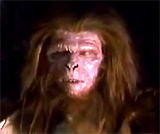 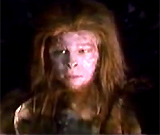 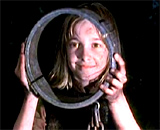 Martia "Morphing" From "Brute" Into a Blonde Child 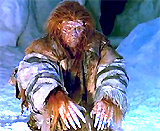 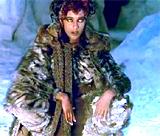 Martia Morphing Back into "Brute" Character 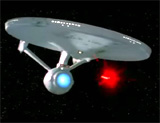 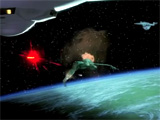 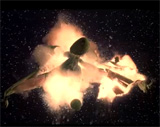 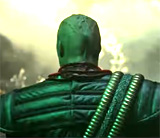 Space Battle - Photon Torpedoes Destroyed Klingon Ship and Blew Up General Chang (Christopher Plummer) |
|||||||||||||||||||||
|
Terminator 2: Judgment Day (1991)
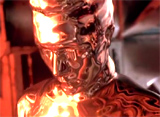
Terminator 2 was the first mainstream blockbuster movie with multiple morphing effects and simulated natural human motion and realistic movements for a major CG character. It was the first film to use 'personal' computers to create its special effects, supplementing its traditional use of puppets and other practical effects. The lethal, liquid-metal, chrome T-1000 cyborg terminator (Robert Patrick) was the first computer graphic-generated main character to be used in a film.
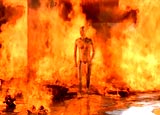
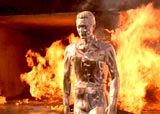
He was capable of 'morphing' into any person or object. The liquifying-solidifying robot's humanoid texture was layered onto a CG model to create the effect. Over 300 special effects shots made up 16 minutes of the film's running time. The seemingly-indestructible Terminator android composed of morphing liquid metal was a killing, shape-shifting terminator with no emotional intelligence, usually exemplified as a policeman. The sleek, modern android was composed of poly-mimetic metal, meaning it could take on the shape, color, and texture of anything it touched (such as a porcelain-tiled floor or metal bars), and could also mimic human behavior, such as imitating the voices of its victims. It could transform its hands into jaw-like blades for impalement, and completely absorb shotgun blasts to its midsection or head. After a fiery big-rig crash in the LA flood channel, the T-1000 walked unscathed out of the flames - revealing his metallic frame before reverting back to humanoid form.
In another remarkable scene, the T-1000 was shattered into pieces, but then the pieces reassembled themselves.
Also, in post-production work, the truck crashing through the wall was flipped from left to right to create a better angle. In the same year, Michael Jackson's promo music video Black or White (1991), directed by John Landis, also used morphing (in its final sequence) - the first video to do so. |
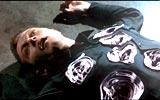 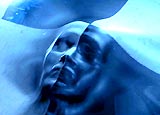 Morphed Into the Floor 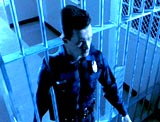 Walking Through Steel Bars 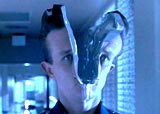
The T-1000 Cyborg Terminator Remarkable Abilities - Absorbing Shotgun Blast 
The Shot-Gun Blast to the Body of T-1000 (Impersonating Sarah) |
|||||||||||||||||||||




 Special
FX brought this epic James Cameron film recognition by the Academy
- Best Achievement in Visual Effects for Industrial Light & Magic
(ILM), defeating two other contenders:
Special
FX brought this epic James Cameron film recognition by the Academy
- Best Achievement in Visual Effects for Industrial Light & Magic
(ILM), defeating two other contenders: