|
Special Effects (F/X) - Milestones in Film 1921-1929 |
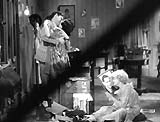
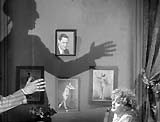
The Power of Love (1922) This was the world's first 3-D feature film shown to a paying film audience (not Bwana Devil (1952)). It was projected dual-strip in the red/green anaglyph format, making it both the earliest known film that utilized dual strip projection and the earliest known film in which anaglyph glasses were used. One of its alleged firsts was that it was the first film to have an alternative ending - happy or sad (both shot in 2D) - so that the viewer could select (by looking through either the red or green lens of the spectacles) which ending was preferred. The film utilized and may have been the only commercial film produced in the dual-camera, dual-projector system developed by Harry K. Fairhall and Robert F. Elder. The film is now considered lost. The story was a melodrama about a deadly love triangle set in Southern California between:
In the plot, Alvarez framed O'Neil for theft and the stabbing-murder of an old Padre (John Herdman), and then attempted to shoot him, although Maria shielded her lover and was wounded instead. Alvarez was convicted of the crimes, and Maria wed O'Neil. |
||||||||||
|
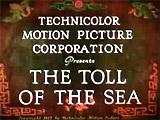
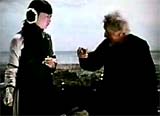
The Toll of the Sea (1922) This five-reel film (approx. 54 minutes) debuted as the first general release (widely-distributed or commercial) Hollywood feature film to be projected in color and to use the improved two-tone Technicolor process. The leading lady in the film was Anna May Wong -- the first big-name Chinese-American actress - who played the role of Lotus Flower. |
|
||||||||
|
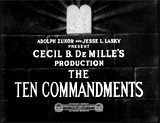
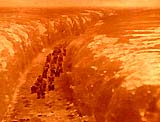
The Ten Commandments (1923) This early Cecil B. DeMille epic used primitive special effects techniques - the parting of the Red Sea was accomplished by filming water as it poured down two sides of a U-shaped tank, and then running the film backwards - to make the water appear to divide. The illusion of keeping the walls of water separated was accomplished by slicing a slab of jello in two and filming it in closeup - and then combining (or double-exposing) it with live-action footage of the Israelites walking into the distance and the Egyptian chariots in pursuit. |
|
||||||||
|
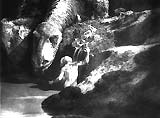
Die Nibelungen: Siegfried (1924, Ger.) (aka Siegfried) Director Fritz Lang's two-part fantasy epic film was based on German legends - it was noted for its special effects creation of a giant, 50-foot fire-breathing dragon named Fafnir. The slow-moving mechanical creature required seventeen technicians to operate. |
|
||||||||
|
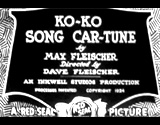
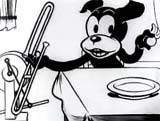
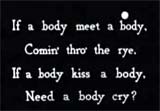
Ko-Ko Song Car-Tunes (1924-27) The Fleischer Brothers made the first animated films (cartoons) that featured a soundtrack, a series of 36 films released in the mid-1920s that were the precursors to karaoke. The first sound cartoon was one of the Song Car-Tunes -- Mother Pin a Rose on Me. They were also the first audience participation films, with sing-along lyrics and a 'bouncing-ball' helper. They included Has Anybody Here Seen Kelly? (1926), When The Midnight Choo-Choo Leaves For Alabam' (1926), Comin' Tho' The Rye (1926), Margie (1926), My Old Kentucky Home (1926), Tramp, Tramp, Tramp-The Boys Are Marching (1927), By The Light Of The Silvery Moon (1927). In My Old Kentucky Home, Bimbo said to the audience: “Follow the ball and join in everybody." Twelve of the 36 Car-Tunes films were produced with the actual DeForest sound on film process. |
|
||||||||
|
The Thief of Bagdad (1924) The astounding visual effects included:
|
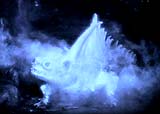 Dragon 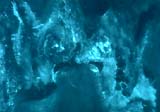 Underwater Spider 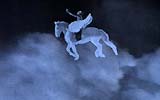 Flying Horse 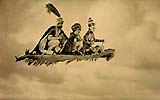
Flying Carpet |
||||||||
|
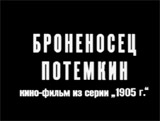
Battleship Potemkin (1925, Soviet Union) (aka Броненосец Потёмкин) Sergei Eisenstein's Russian film was famous for its pioneering, revolutionary and innovative use of montage - a rhythmic juxtaposition of unrelated, cross-cut images that created associations in the audience's mind of a violent massacre - although mostly unseen. The famed Odessa Steps sequence contained 155 separate
shots, using editing and cutting to convey heightened emotion and dramatic
meaning, with close ups (some extreme), long shots, camera pans in
every direction and subtle time shifts. |
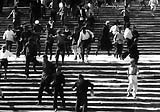 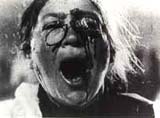 Odessa Steps Sequence |
||||||||
|
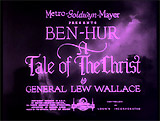
Ben-Hur: A Tale of the Christ
(1925) It was filmed with some two-color Technicolor sequences (e.g., the triumphant processional sequence). |
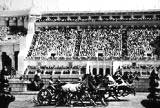 Chariot Race 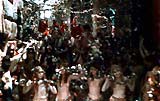 Processional Sequence in 2-Color |
||||||||
|
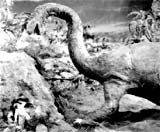
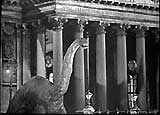
The Lost World (1925) Willis O'Brien, later famed for King Kong (1933), was responsible for this pioneering film's first major use (primitive) of stop-motion animation in a feature film - especially the sight of a brontosaurus running wild in the streets of London, and knocking down people with its tail. O'Brien used small-scale puppet models that were filmed frame-by-frame on miniature sets and landscapes. Live action and stop-motion animation would be combined by putting the two negatives together using split-screens. This film also used the technique of a traveling matte (the process of adding a moving element to a frame so that it could be separated as an element and combined with a different background) - for example, in one sequence (top image), actress Bessie Love was matted into the frame as she cowered below the Tyrannosaurus. |
|
||||||||
|
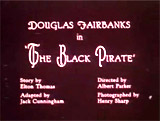
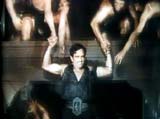
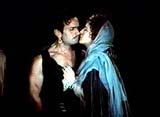
The Black Pirate (1926) Actor-producer-star Douglas Fairbanks' ultimate pirate film (silent) was historically significant - the adventure swashbuckler was the first full-length blockbuster color film. (The two-color process was first introduced in The Toll of the Sea (1922) - see above, and in some sequences of Ben-Hur: A Tale of the Christ (1925) - also see above.) It boasted the use of an experimental early Technicolor (two-color) process, although it was also filmed in black and white. |
|
||||||||
|
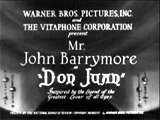
Don Juan (1926) Using its newly developed Vitaphone (sound-on-disk) process, Warners Studios added a score and sound effects to this John Barrymore silent already in production, beginning a revolution in sound. It was the first mainstream film that replaced the traditional use of a live orchestra or organ for the soundtrack (a recorded musical score of the New York Philharmonic), and successfully coordinated audio sound on a recorded disc synchronized to play in conjunction with a projected motion picture. The sounds in the film consisted of some sound effects and music, but no dialogue. |
|||||||||
|
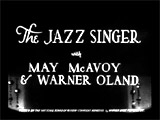
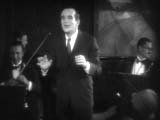
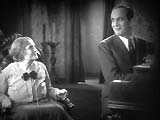
Although this film was not the first sound film, nor the first 'talkie' film or the first movie musical, it was the first feature-length Hollywood "talkie" film in which spoken dialogue (synchronized) was used as part of the dramatic action. Audiences were wildly enthusiastic when America's favorite jazz singer and superstar Al Jolson broke into song, ad-libbed extemporaneously with his mother at the piano while singing "Blue Skies", and proclaimed the famous line to introduce a musical number:
|
|
||||||||
|
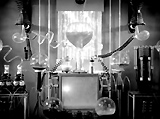
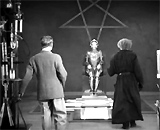
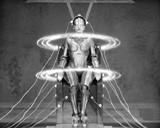
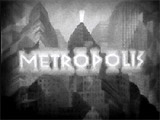
Fritz Lang significantly advanced the art of using elaborate model miniatures to create vast city-scapes. In the film's opening, animated airplanes fly above the futuristic dystopian city filled with more animated automobiles. Miniatures were first used in Georges Melies' A Trip to the Moon (1902, Fr.). Other perspective techniques created the illusion of distance and size. The film also employed matte paintings, complex compositing, and back or rear projection (for example, the scene of ruling Master Joh Fredersen (Alfred Abel) speaking to his foreman Grot on a video-phone TV screen). And many details of the film were technical marvels, including crazed scientist-inventor Rotwang's (Rudolf Klein-Rogge) lab, the unveiling of the robot, and the rings rising and falling on the robot (a multiple exposure shot).
It was the first film to successfully use the German Schufftan process -- an in-camera, optical special effect that was an early precursor of the bluescreen. The process used mirrors to create the illusion of live actors in huge sets (that were actually miniatures of scenery composed of painted or modeled backgrounds), such as the scene set in the sports stadium. This early process was soon replaced by the simpler, more efficient matte method and by bluescreen effects. This technique was also used in Disney's Darby O'Gill and the Little People (1959). |
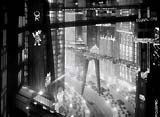 Use of Miniatures - The Futuristic City 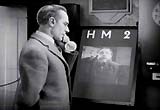 Rear Projection - The Video TV Screen Scene 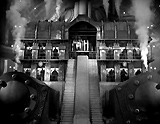 The Metropolis Machines 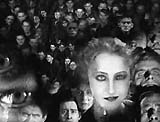 Multiple Images 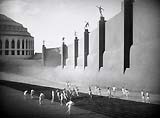 The Sports Stadium |
||||||||
|
Napoleon (1927, Fr.) This milestone film from Abel Gance was the first in stereo sound. Two years after its release, it was first shown on triple screens using three projectors in Paris in January of 1929 - a foreshadowing of Cinerama or 'widescreen' films. The finale was a spectacular triptych played on three screens that, together, measured about 90 feet wide. Three different images were projected in synchronization by three separate cameras, a technique known as Polyvision. It was a remarkable masterpiece, innovatively overlaying double exposures and dissolves, and composing multiple images in the same frame. It was also famous for its use of split screens, ultra-wide scenes, a moving camera (Gance mounted cameras on horses, elevators--even guillotines--to achieve unusual effects), and color tinting to illustrate setting or mood: blue tones for night and red-orange for the battle of Toulon. |
|
||||||||
|
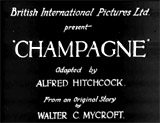
Champagne (1928, UK) The first reported example of the use of "freeze-frame" (the film term for a special effect camera shot or optical technique that halts the action on a single frame of film, giving the impression of a still photo) was in one of director Alfred Hitchcock's lesser silent era films. It was his early British romantic comedy film, Champagne (1928, UK) starring Betty Balfour as the Girl, a young, spoiled and headstrong New York heiress - the daughter of the "Champagne King" - a "Wall Street Magnate" (Gordon Harker). In the visual effects shot (at the 47 minute mark), a group of dancers on a Cunard Lines cruise ship (enroute to Paris, France) during a New Years' Eve soiree in a ballroom were suddenly freeze-framed or paused, then as the image pulled back with a reverse tracking shot, it transitioned (with an imperceptible jump cut) to become a framed picture in a shop's display window, labeled: "NEW YEARS EVE AQUITANIA." The Girl was dreaming and imagining the party that she had attended on the ship, before the transition to the photograph, that she was viewing from the sidewalk.
There was also an interesting shot (essentially repeated twice, both in the opening and in the conclusion) with a giant champagne glass used as a prop. In the first instance, after the removal of the wired top of a champagne bottle (in gigantic closeup, using a large prop), and the pouring of the champagne into a glass, the drinker looked through the bottom of the glass to see a crystal ball-like view of dancing couples onboard an ocean liner. The glass served as a fish-eye lens. The same type of shot occurred in the conclusion, to view the kissing of the happy couple, the Boy (Jean Bradin) and the Girl, about to get married. |
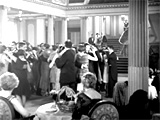 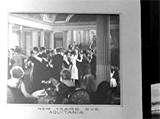 "Freeze-Frame"  Opening  Closing |
||||||||
|
Noah's Ark (1928) Originally a silent film - and then made into an early 'talkie' a year later (with several stultifying scenes of Vitaphone sound-on-disk dialogue) -- this early romantic drama and disaster film was about the Biblical (Genesis) story of the 'Great Flood.' It was directed by Michael Curtiz, from a screenplay by Darryl Zanuck. In its original premiere form, it was about 135 minutes in length, although later shortened by about a half-hour. The surviving prints are about 108 minutes long. This was Warner Bros.' answer to Cecil B. De Mille's Biblical epics of the 20s (especially the silent film The Ten Commandments (1923)). It was Warners' most expensive film to date - costing over $1 million. The early religious epic about Biblical times and the sins of mankind was intercut with a parallel melodramatic romance story about soldiers in the Great War (WWI) - with moralizing about the hedonistic sins of the Jazz Age and Wall Street speculation.
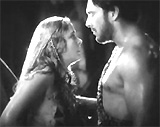
The parallel intercutting in the film was reminiscent of D.W. Griffith's Intolerance (1916), with actors playing roles in both sections. Paul McAllister portrayed two roles: Noah and a Minister, who decried sin and worship of the pagan god Jaghuth. The two stars in a romantic relationship were:
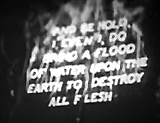
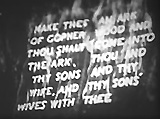
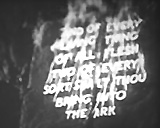
In a scene reminiscent of Cecil B. DeMille's earlier Biblical epic The Ten Commandments (1923), Noah (a Moses figure) went on a mountain trek where, in a dramatic scene, he experienced a Burning Bush and the creation of two giant stone tablets on a mountainside with flaming letters (written by lightning) warning of a giant flood and his commission by God to build an Ark to escape:
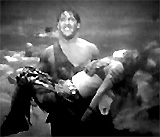
Just before the flood, virginal Miriam, Noah's handmaiden (betrothed to Noah's youngest son Japheth (George O'Brien)) was randomly chosen to be sacrificed by King Nephilim (Noah Beery) of Akkad to his God Jaghuth - as the high priest's archer drew back his bow and arrow to execute her high upon an altar, he was struck by lightning, and Miriam was saved from execution. Its major scene was of a climactic flood - that mixed miniatures, double-exposures, and the full-scale destruction of actual sets. Reportedly, when stored tanks of thousands of gallons of water were released for the sequence upon hundreds of unsuspecting extras, three of them died from drowning, and many others were severely injured. The imprisoned but now-freed (but blinded) Japheth heard Miriam's cries for help as she was threatened with being swept away in the currents. He rescued her from the water by picking her up to save her from drowning; with the water flowing down his face, his blindness was miraculously cured, as he brought her to the Ark on the outskirts of the city.
Those pagans that were still alive clamored to enter the Ark as it slowly floated away; King Nephilim's attempt failed when the door slammed onto his hand; all others were unsuccessful "and all living things - PERISHED!" |
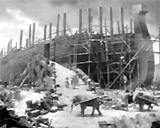 The Building of the Ark 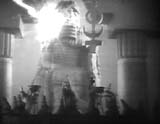 The Destruction of the Massive Temple 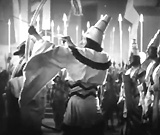 Archer Struck by Lightning 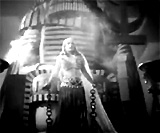 Miriam Atop Altar 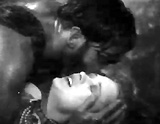 Miriam Rescued by Japheth From Flood Waters 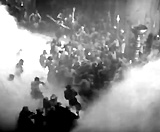 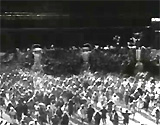 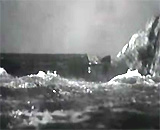 The Great Flood: Storms and Torrents of Water 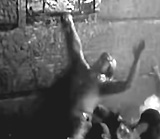 King Nephilim's Vain Attempt to Enter Ark |
||||||||
|
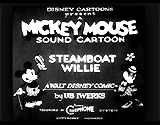
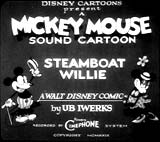
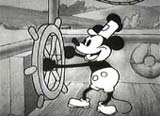
Steamboat Willie (1928) The 7-minute Steamboat Willie was first released (on a limited basis) on July 29, 1928, with Mickey as a roustabout on Pegleg Pete's river steamer, but without his trademark white gloves. It was then re-released on November 18, 1928 with sound and premiered at the 79th Street Colony Theatre in New York. It was the first cartoon with a post-produced synchronized soundtrack (of music, dialogue, and sound effects) and was considered Mickey Mouse's screen debut performance and birthdate. Although it was Mickey's second film (the first was Plane Crazy (1928)), it was his first with sound. The Fleischer Brothers' were earlier credited with the first animated films with sound, in their mid-1920s series of Song Car-Tunes. |
|
||||||||
|
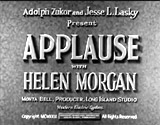
Applause (1929) This early film from director Rouben Mamoulian was visually stylistic (with dramatic light and shadows), with exceptionally-striking and graceful camera work -- it marked the first use of a moving sound camera instead of using long static shots. Also it had interesting, unusual, and revolutionary camera angles (from above and below) including a triangulated shot showing two simultaneous actions, the first innovative use of background sound, and it was the first film made with a two-channel or two-track monophonic mix.
|
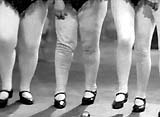 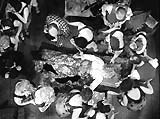 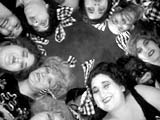 Innovative Camera Work |
||||||||
|
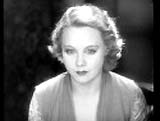
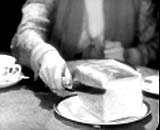
Blackmail (1929, UK) Hitchcock's first talkie (and the UK's first full-length talkie also) was exceptionally ahead of its time, with an innovative use of sound to heighten the tension in this thriller. In the famed breakfast scene, the word "knife" was repeated and amplified in the everyday conversation for the guilt-ridden heroine Alice White (Anny Ondra) after she had stabbed her assailant Mr. Crewe (Cyril Ritchard) with a large bread knife when he sexually assaulted her. The film also used the German Schufftan process (first used in Fritz Lang's Metropolis (1927)), an early blue-screen precursor, in the police's chase scene of blackmailer Tracy (Donald Calthrup) through the Library/Reading Room and the Egyptian wing of the British Museum and across its domed rooftop. |
|
||||||||
|
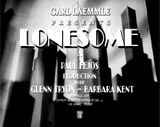
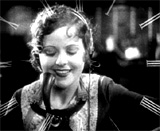
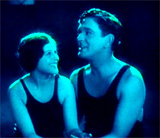
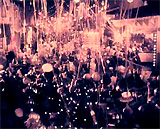
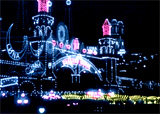
Lonesome (1928) Hungarian-born director Pal Fejos' silent film (a part-talkie actually) was a heart-warming, sentimental romantic melodrama with a bit of sound (a few dialogue scenes featured synchronized sound). It was presented with some very innovative and expressive camera effects for the time (three color tinting, superimposition and double-exposure effects, ie, the Roman numerals of an enclosing clock around the female character, experimental editing, and a roving kinetic camera). The story was about two average, desperately-lonely singles in the hustle-bustle big city of New York, who lived in tiny apartments: metal factory worker Jim (Glenn Tryon) and switchboard operator Mary (Barbara Kent). There were contrasting similarities and parallels between their two work-days, and unbeknowst to them, they lived next-door to each other. After casually meeting on a Fourth of July weekend trip to Coney Island where the two fell in love (during typical activities including the beach, a fortune teller, a photograph booth, a ball-tossing carnival game, a spinning wheel, a fun-house mirror, fireworks, and a roller coaster ride), they became separated during a thunderstorm and only knew each other's first names! The key to finding each other was in the surprise ending -- a 78 rpm spinning phonograph record of Irving Berlin's 1925 hit song Always, played in Jim's small apartment, with the lyrics: "That's when I'll be there, always" (on the soundtrack). It was the tune that he and Mary had danced to in the Coney Island dance hall. When it was heard by Mary in her next door apartment, she pounded on the wall in distress - and realized when he entered her place that he was her next door neighbor! |
|
||||||||
|
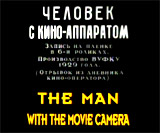
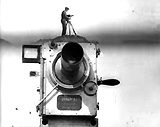
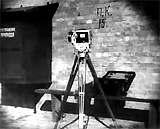
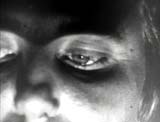
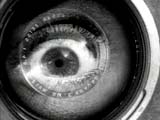
The Man With a Movie Camera (1929, Soviet Union) (aka Chelovek s Kino-Apparatom, or Человек C Kино-Aппаратом) Soviet director Dziga Vertov's quintessential experimental, avante-garde film was an excellent example of a "city symphony" documentary. The fast-moving, free-association of images (over 1,700 shots and scenes of everyday life), all presented with an average of 2.3 seconds per shot length - was wholly unprecedented in the late 1920s. Regarded as "pure" visual cinema, it presented views of Moscow, Kiev, Odessa and of Soviet workers and machines, among other things. Its radical hyper-editing techniques included variable camera speeds, dissolves, special visual effects, stop-motion, wild juxtapositions of images, freeze frames, split-screens, and super-imposed double exposures. The film's most famous double-exposure was the camera-trickery shot of a cameraman setting up his camera atop another camera. The best example of stop-motion were the playful views of the tripod-camera acting anthropomorphically, by rotating its camera-head around, and then beginning to walk away on its three legs. In its ending, there were some views of the actual process of the editing of the film by the cameraman, accentuated by the super-imposed image of a human eye looking out of a camera lens. |
|
||||||||