|
Special Effects (F/X) - Milestones in Film 1997-1998 |

|
Contact (1997) Robert Zemeckis' science-fiction drama was based on Carl Sagan's 1985 novel. It told about the hunt for intelligent life in the universe. Many films in this time period were using a combination of visual effects:
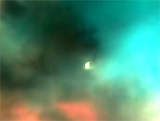
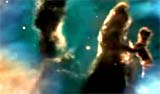
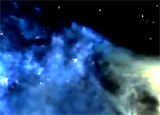
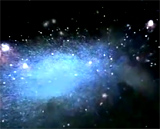
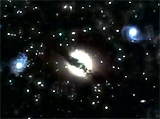
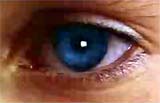
Zemeckis continued to push the envelope in special effects, after his revolutionary work on Who Framed Roger Rabbit (1988), Death Becomes Her (1992), and Forrest Gump (1994). The film contained in its opening a continuous single digital FX shot, reportedly the longest ever created at the time. It was inspired by the short documentary film, Powers of Ten (1977). It was a computer-generated sequence of a virtual camera, with a very slow and lengthy pull-back including the following elements:
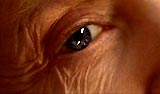
And then, the camera pulled back to reveal that the light from all of these stars was actually the highlight in a young girl's eye, as she was listening to her amateur radio set. The color of the girl's eyes were digitally altered to match the eye-color of young "Ellie" (Jena Malone), the future SETI scientist and radio astronomer Dr. Eleanor "Ellie" Arroway (portrayed by actress Jodie Foster as an adult).
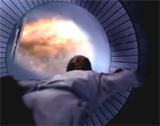
One of the more memorable scenes was the wormhole sequence, prefaced by a giant Machine built as a transport mechanism for intergalactic travel to meet aliens. Ellie had inherited her father's passionate interest in astronomy, although he had died of a heart attack when she was very young. She had been chosen to make first 'contact' with extraterrestrial life. Arroway was placed as the pilot into a single-occupant pod, and 'launched' by being dropped into a set of spinning rings. She vibrated through a series of wormholes providing various views from the outside environment (reminiscent of Kubrick's Stargate sequence in 2001: A Space Odyssey (1968)), and came to a planetary city circling Vega.
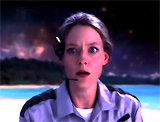
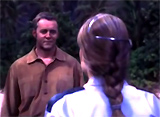
She entered the alien world - a digitally-altered beach, where she experienced a reunion with her 'holographic' deceased father (David Morse). On the side of the beach was a growth of tropical trees, positioned in the same way as a colorful drawing she showed off early in the film. She believed he was an alien taking her father's form, and attempted to ask questions. He replied that her journey was only the first small step to finding other species in space. Two of the other most talked-about shots in the film were:
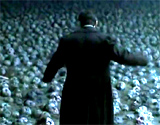
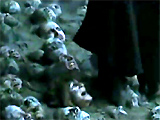
In the mind-boggling, seemingly-impossible-to-film 'tricky mirror' shot - there appeared to be no cameraman or camera. In the flashbacked night-time sequence, young Ellie raced upstairs to retrieve her father's heart pills from a mirrored bathroom cabinet after he had collapsed. The sequence became a slow-motion ordeal, as she ran down the long hallway to the bathroom. And then the camera pulled back to reveal that her sprint down the corridor had been reflected by the mirror on the cabinet's door. She opened the cabinet door, reached for the bottle of pills and then closed the cabinet door. There was a reflection of a framed photo of Ellie with her father sitting on a nearby shelf. The shot was accomplished by fooling the viewer into believing there was actually a mirror on the front of the cabinet. The technique was called compositing - combining different shots and elements into one image. It was a clever combination of two shots: Shot A (a blue-screen shot of Ellie running up the stairs and extending her hand toward the cabinet, filmed by a Steadicam operator running backwards in front of her), and Shot B (a composited shot of Ellie's hand reaching for the cabinet knob). In the second F/X instance, digitally-composited press conference footage of then President Bill Clinton's August 7th, 1996 "Mars Meteorite" speech (about a rock found in Antarctica in 1984 that might prove that there was life on Mars) was recut to appear as if the President was talking about messages received from alien sources, including the receipt of an alien television broadcast featuring Adolf Hitler opening the 1936 Olympic Games in Berlin. In the film, Clinton's speech (cleverly edited) coincided with the themes of the film when he spoke:
|
          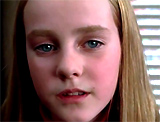
The Film's Long and Complex Opening Shot |
||||||||||||||||

|
Conceiving Ada (1997, US/Germ.) Regarding this fantasy sci-fi drama that was a challenging and heady intellectual film, the film's director Lynn Hershman Leeson, a San Francisco-based photographer and computer-installation artist, stated that the film was structured like the double helix of a DNA strand. It was the first film with 2D all-CGI backgrounds (digitized virtual sets) before which live actors performed. The filmmaker used a new bluescreen filming process in which a number of photographs, taken in Victorian bed and breakfasts in the San Francisco Bay area, were dynamically placed into the main protagonist's world as backgrounds. They were composited or inserted into the film in real time (not in post-production), so that the actors could see their interactions with the background on set. The main character in this fantasy sci-fi drama, was 19th century mathematician Ada Augusta Byron King (Tilda Swinton), Countess of Lovelace, the first computer programmer. She was noted as the first to write a computer language. Historically, Ada worked with Charles Babbage on his Analytical Engine - the first "computer" - although it was mostly a mechanical counting device. In the film's story (involving a bit of cyber time travel), a connection was made with Ada across cyberspace by another woman who became obsessed with her:
Emmy's mentor Sims (Timothy Leary) suggested that she use DNA in her program (related to her recent pregnancy) to tap into past information and make a direct connection with Ada. Emmy began to retrieve information from the past and even directly communicate with Ada, on "March 11, 1883" - and thus started a two-way discussion with the dead woman's image. |
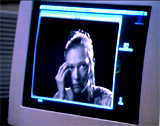 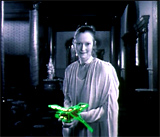 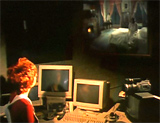 Communicating with Ada 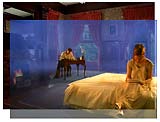 Digitized Virtual Sets in Real Time |
||||||||||||||||
|
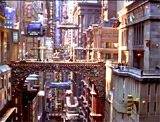
The Fifth Element (1997, Fr.) Writer/director Luc Besson's science-fiction techno-thriller epic, set in a futuristic 23rd century NYC (2263 AD), was noted for its exceptional sets, visual effects and costume designs, and its basic plot-line of good vs. evil. There were an extra-ordinary number of individual FXs in this film (motion control miniatures, CGI, digital compositing and effects simulations, mechanical and practical effects, and 'creature' effects). Its tagline was:
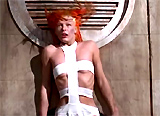
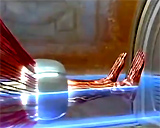
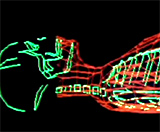
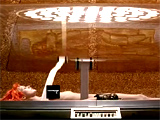
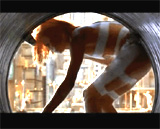
In the story, it was explained that a "Fifth Element" in the form of an other-worldly humanoid, positioned in the center of the four fundamental elements (Earth, Wind, Fire, and Water), would prevent the Great Evil from destroying all of humanity. [Note: The film also referenced Heavy Metal (1981).] In the regeneration or reconstruction sequence set in a NY nucleolab with a team of scientists, a Perfect Being (Fifth Element) was resurrected. The Fifth Element was a beautiful nude woman with orange hair - an extra-terrestrial female named Leeloo (Milla Jovovich). A sophisticated machine built her skeleton and strapped muscle tissue onto the bones, using computer animation effects.
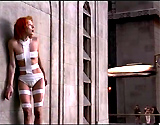
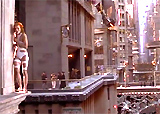
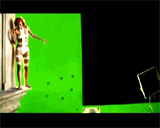
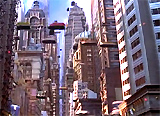
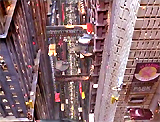
When Leeloo escaped from the lab, she found herself standing on a narrow building ledge, looking out at a futuristic New York City skyline, with airborne vehicles whizzing by.
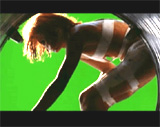
The exterior shots of the New York skyscrapers were a massive model (some of the model was blue-screened when Leeloo was on the ledge), while the cars were CG.
Leeloo was teamed up with cab-driver and former soldier Major Korben Dallas (Bruce Willis) after literally diving off a multi-story Manhattan building into his vehicle. Its most celebrated sequence was the cab chase with flying cars. The cars were created both as motion-control models and CGI versions. The immense 2,000 foot long pleasure cruiser - the Fhlostin Paradise - was a motion-control model. It was the largest model ever built for a film (at the time), and weighing 7,500 pounds. |
  Leeloo on a NYC Building Ledge 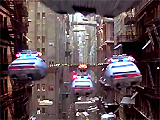 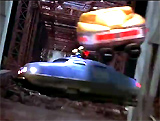 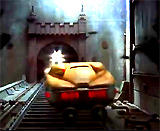 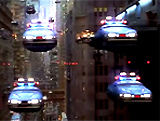 Cab Chase Sequence 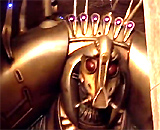 Mondoshawan 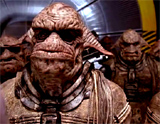 Mangalores - "Creature" Effects 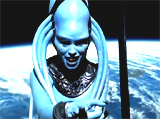 Diva Plavalaguna (Maïwenn)  The Fhlostin Paradise |
||||||||||||||||
|
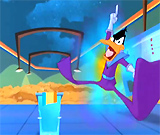
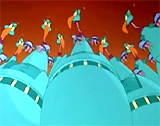
Marvin the Martian in the 3rd Dimension (1997) This 12 minute Warner Bros. film was the first computer-animated CG film that was to be viewed with 3-D glasses. It was a composition of two different art forms:
It combined the experience of watching a fully CGI film with polarized/anaglyphic glasses. Its main characters were soft-spoken Marvin, and Martian hunter Daffy Duck. At one time, it was a feature of the Warner Bros.' theme park "Movie World" in Australia (Queensland).
|
|
||||||||||||||||
|
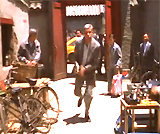
Red Corner (1997) Director Jon Avnet's mystery thriller was controversial for being critical of the draconian Chinese government at the time. It starred Richard Gere as an American businessman who was charged with murder while in China doing business with the government regarding a satellite communications deal. He was declared the rapist and murderer of exotic model Hong Ling (Jessey Meng), the daughter of a high-ranking official. His court-appointed Chinese lawyer Shen Yuelin (Bai Ling) at first insisted that her client file a guilty plea, hoping he would receive leniency for confessing. However, both of them soon uncovered evidence of the frame-up, and exposed judicial, civil and political abuses.
Digital visual effects allowed the production to appear to have been completely shot in actual Chinese locations, but that was in fact disallowed by the Chinese government. The entire film was shot in Los Angeles with elaborate sets and CGI rendering. However, just before filming, Avnet had been to Beijing where he shot footage (without government permission), and was able to capture the first-ever 35mm film of the city to appear in a Hollywood film. Most of the landscape and Beijing city shots (many under the opening credits) were comprised of 2D and 3D matte paintings based on hundreds of still photographs of the Chinese city. |
|
||||||||||||||||
|
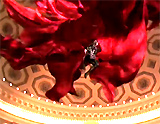
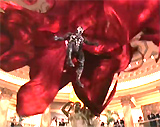
Spawn (1997) Director/co-writer Mark A.Z. Dippé's violent and bloody supernatural superhero film was an adaptation of the comic-book of the same name by Todd McFarlane. It was the first film with an African American actor, Michael Jai White, portraying a major comic book superhero. Before becoming Spawn, Al Simmons was a special forces government assassin who was betrayed and murdered, and then came back from Hell to Earth. With a Faustian contract, the anti-heroic Spawn (or Hellspawn) chose to be a demonic, super-powered leader of Hell's army in Armageddon in order to return to Earth. A third of the film's $40 million budget was spent on visual effects, requiring almost a year to complete. Visual effects included a combination of prosthetic makeup, animatronic creatures, and CG work. There were two very impressive or simulated CGI visual effects (by ILM):
There were also some impressive transformations of Spawn with CG animation, including the appearance of chains, hooks, and knives that emerged from his body. In a scene involving a stunt double thrown by Spawn against a dumpster, wires on the double's flying rig were digitally erased. |
  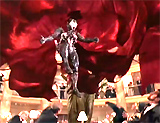 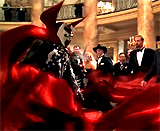 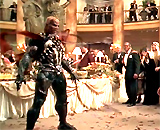 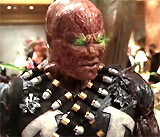 Spawn's Dramatic Cape Entrance |
||||||||||||||||

|
Starship Troopers (1997) Director Paul Verhoeven's science-fiction action film was the first to feature a large-scale, interstellar CGI battle between alien insectoid creatures and the military. An army of futuristic soldiers was locked in visceral, gory combat against a frightening array of thousands of giant alien, spider-like bugs or arachnids (aka archies), from the distant world or planet of Klendathu.
The swarming creatures were entirely created with CGI technology (although some of the monstrous insects were robotic models with a custom "Bug Input Device" that allowed puppeteers to animate the 3D warrior bugs in real time). |
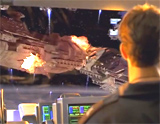 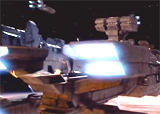 Giant Spaceships |
||||||||||||||||
|
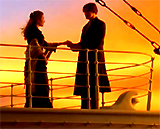
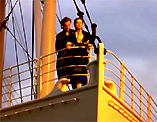
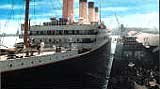
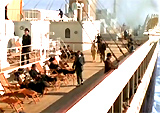
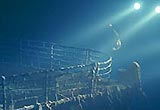
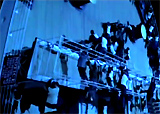
Titanic (1997) James Cameron's film was the most expensive film ever made - up to its time, at approximately $200 million. And it was the first film to reach the billion-dollar threshold (worldwide).
It was noted for its large scale use of motion-capture and 3D digital crowd extras. With stunning, costly digital effects in a historical epic/drama - computers were used to create:
Both CG and miniature models (and lots of stuntpeople) were used to portray the ocean-liner as it tilted (on a massive set), split in two, and sank in the tragic finale - into enhanced CG water. |
|
||||||||||||||||
|
Antz (1998) Following Toy Story (1995), this DreamWorks adventure-comedy was the second fully computer-animated feature, preceding the release of Disney's/Pixar's all-CGI insect epic A Bug's Life by seven weeks. With its success, it helped to ensure the future of the new medium - feature-length animations with 3D computer graphics. This was also the first CGI film to feature over 10,000 individually-animated characters in various crowd scenes (such as the Starship Troopers-like battle). Over 40% of the shots in the film were crowd shots. Also, it incorporated new muscle-based facial animation tools. A few of the characters shared facial features with their voice actors, such as soldier ant Weaver (Sylvester Stallone), and Z (Woody Allen) as a paranoid, nervous, and unhappy worker ant.
It was the first computer-animated film to receive a PG rating, and the first computer-animated feature film to use computer software to create and simulate the properties of water -- hence, digital water, especially in its flood sequence. |
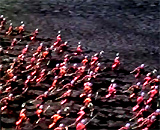 Crowd Battle Scene 
 Digital Water |
||||||||||||||||
|
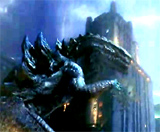
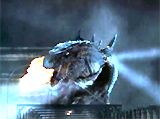
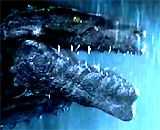
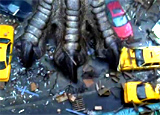
Godzilla (1998) Director Roland Emmerich's sci-fi monster movie was a re-envisioning of the original classic 1954 Japanese film known as Gojira (and released a few years later in a US version titled Godzilla, King of the Monsters! (1956)). It was notable as the first Godzilla film to be completely produced by a Hollywood studio. The vast majority of the film's giant monster/lizard was computer-generated, including the terrifying monster's baby hatchlings, the helicopter shot of the beached tanker found on the Panamanian coast, and the finale's fully-digital Brooklyn Bridge scene, when the CGI monster chased a taxi-cab and stomped across the CGI span (snapping cables and crumbling the road).
There were about 400 visual effects shots in the film, including about 235 Godzilla CGI shots, and just a few animatronic shots of the monstrous beast. |
|
||||||||||||||||

|
Mighty Joe Young (1998) Director Ron Underwood's adventure film was a remake of the original 1949 film. There were a number of visual effects techniques for "Mighty Joe Young":
It was noteworthy for the creation of groundbreaking "hair, fur and feathers" technology for the CGI gorilla's hairy coat. |
|
||||||||||||||||

|
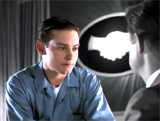
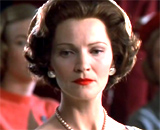
Pleasantville (1998) Director Gary Ross' directorial debut film was this fantasy comedy-drama with the tagline: "Nothing Is As Simple As Black And White." This referred to the F/X shots for much of the film, in which black and white characters interacted with color characters, in the same shot. According to Guinness, Pleasantville had the most computer generated effects in a film to date - 1,700 digital visual effect shots, compared to the average Hollywood film which had 50 at the time. The next film to have a larger number of digital effects shots was Star Wars: Episode I - The Phantom Menace (1999). After shooting the film entirely in color, it was scanned, processed, and recorded digitally. Most of the effects in this time-travel fable involved selectively de-saturating the color film, and digitally adjusting the contrast. The plot was about teen twin siblings (in a divorced family) in contemporary suburbia:
The two were transported from the cynical '90s into a '50s black-and-white sitcom (titled "Pleasantville") and a world of stereotypical perfection and nostalgic, safe and traditional values.
When they were zapped back to the 50s while fighting over the TV's remote control, they took on new names and their 'Ozzie-and-Harriet' parents on the Pleasantville b/w TV sit-com became:
As their lives began to change, and the peaceful blandness of the 50's was challenged and people were liberated (through sex and other unknown but needed desires), various characters or objects began to appear in "living color." |
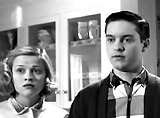 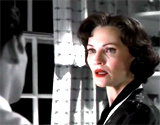 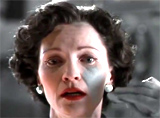 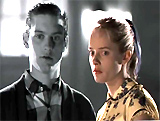  
|
||||||||||||||||

|
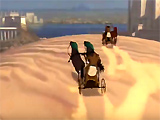
The Prince of Egypt (1998) This DreamWorks SKG's' animated musical feature/epic, its first traditionally animated film, was about the life of Moses and the Hebrew Exodus from Egypt. It was the first animated feature to be developed around a Biblical story. It was the most expensive, classically-animated feature film at the time, budgeted at $60 million, and took four years to bring to the screen. It had a blend of both traditional animation and CGI for its visual effects. It was the first animated feature film to use major Hollywood stars in all the voice parts. The film included 1,192 special effects -- its most spectacular and breath-taking moments were:
One of its scenes depicted a 16,000 person crowd, as the Hebrews fled Egypt during the Exodus. One of its technological milestones was to seamlessly bring together CG 3-D models and traditionally-drawn 2-D characters and settings in a single shot, using a revolutionary piece of software known as the "Exposure Tool." For example, in the chariot race sequence between the young Pharaoh Rameses (voice of Ralph Fiennes) and Moses (voice of Val Kilmer), the chariots and background were 3-D CG models, while the characters and horses were 2-D classically-animated (or hand-drawn).
The film also created an animated crane shot that looked very much like a live-action shot - as the camera lifted up to the sky to reveal the wide horizon of the Egyptian Empire. |
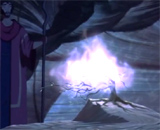 The Burning Bush 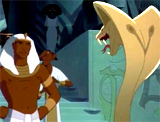 Moses' Staff Turning Into Cobra in Front of Egyptian Pharaoh 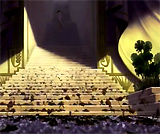 Plague of Frogs 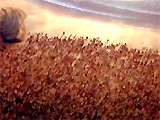 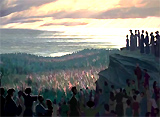 The Hebrews in Exodus Approaching Red Sea 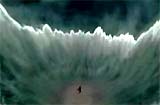 Parting of Red Sea |
||||||||||||||||
|
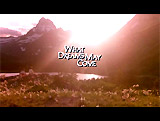
What Dreams May Come (1998) It depicted an imaginative and impressionistic visuals and richly vibrant landscapes of the after-life world. The most striking was the vivid "paint world" in which the entire heavenly world was an expressionistic, colorful landscape literally made of paint. Heaven was pictured dreamily, while there were equally impressive and imaginative vistas and scenarios in an imprisoning dark Hell.
The visuals were in the imagination of deceased pediatrician Chris Nielsen (Robin Williams), whose "soulmate" wife Annie (Annabella Sciorra) was a painter. Chris' concept of the great afterworld was also manifested in his wife's art. In the scenes of an Expressionist painting world in Chris' imagined heaven (using surreal Oscar-winning CGI effects), he was told:
In this idyllic world, he subconsciously created his own eternity as a landscape acrylic still in the process of being painted. While his vision continued to be fashioned and created, he could squish a blue flower in his hand and see the wet paint goo.
|
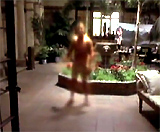 Chris Blurred After Death   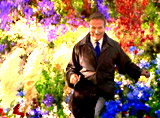  
|
||||||||||||||||














 Winner of the Academy
Award for Best Visual Effects, defeating Starship Troopers (1997) and The Lost World (1997).
Winner of the Academy
Award for Best Visual Effects, defeating Starship Troopers (1997) and The Lost World (1997).