|
Special Effects (F/X) - Milestones in Film 1960-1969 |
|
The Parent Trap (1961) Disney's family film, starring teen idol Hayley Mills, used the process of doubling. The story was about identical twins Sharon McKendrick and Susan Evers (both Mills), separated at birth, who met by chance at Miss Inch's Summer Camp For Girls where they became rivals. In the plot, after discovering that they were sisters, the teenaged twins decided to reunite their divorced parents - Mitchell "Mitch" Evers (Brian Keith) and Margaret "Maggie" McKendrick (Maureen O'Hara). Part of their scheme was to have identical haircuts and to switch places. Although the screenplay originally had only a few trick photography shots using split-screen technology, the number of them was increased when it was seen how seamless the processed shots appeared. The same scene was shot twice, with filmers locking the camera in position and shooting the scene a second time. Each part of the frame was then combined onto a single negative. The film convincingly put two Hayley Mills into the same frame, but the shots were usually pretty obvious in light of recent developments in visual effects. Body doubles (Susan Henning) were also used throughout. |
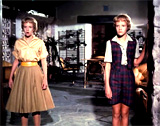
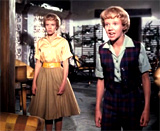 Two Twin Girls, Separated at Birth (both played by Hayley Mills) |
|||||||||||||||||||||||||||||||||||||||||||||||||||||||||||
|
The
Birds (1963) Ub Iwerks was nominated for an Oscar for Best Achievement in Special Effects, but lost to Cleopatra (1963). Real birds and animatronic birds were used throughout the film. One of the film's most famous scenes was the one of dozens of birds slowly gathering on playground equipment - a complex special-effects shot that optically combined over two dozen separate elements. Shortly later during the scene of the bird-attack at the school, special effects combined the shot of the schoolhouse in the background with kids running on a treadmill in the foreground. In another frantic scene of flames and flapping, screeching birds, the female protagonist sought shelter in a telephone booth where she became trapped Advanced rotoscoping and male/female traveling mattes were used in the 20-second scene of hundreds of birds flying over an aerial view of the town - a combination of real live-action footage with hand-drawn matte paintings. |
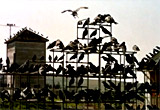 Birds Amassing on Jungle-Jim Outside School 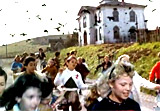 Bird Attack at Schoolhouse 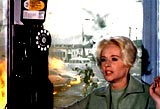 Trapped in a Telephone Booth Sequence 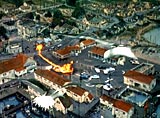
Birds Attacking Town |
|||||||||||||||||||||||||||||||||||||||||||||||||||||||||||
|
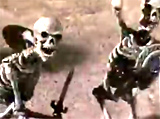
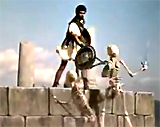
Jason and the Argonauts (1963, US/UK) The Ray Harryhausen-created scenes in Columbia Pictures' fantasy adventure film deserved special mention -- especially the spectacular stop-motion dueling-skeletons scene between Jason (Todd Armstrong) and sword-wielding attackers, in which life-like puppets-models were manipulated and shot one frame at a time. The four-minute skeleton fight took over four and a half months to shoot via stop-motion animation. It also incorporated rear-projected footage of the actual argonaut actors battling with swords (into thin air, actually) - the shots of the skeletons were then combined to make a realistic battle sequence.
The film was also noted for its other amazing creatures, including the gigantic moving (and creaking) bronze statue Talos (the guard of Crete), the sea god Titan holding the Clashing Rocks from destroying Jason's ship, the 7-headed Hydra, and two half-human, half-bird Harpies. |
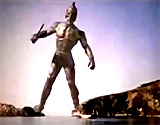 Talos Statue 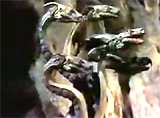 7-Headed Hydra 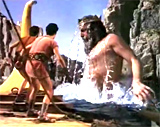 Sea God Titan |
|||||||||||||||||||||||||||||||||||||||||||||||||||||||||||

|
Mary Poppins (1964)
The musical fantasy blended live-action with animation, such as the magical approximately 15 minute sequence in which Julie Andrews (as flying nanny Mary Poppins) and Dick Van Dyke (as Cockney Bert) were transported into the country (one of Bert's drawings) where they frolicked with cartoon penguins, sheep and carousel ponies. The special effects technique (a chroma key process) used in the scene to combine live-action with animated characters and backgrounds was called sodium-screen (or sodium vapor) compositing or matte process - a new dual film traveling matte system similar to the blue-screen process, but using different tools and a new yellow-hued screen. With the sodium vapor process, performers were filmed in front of a white screen lit with sodium vaporlights. The technique was invented by engineer Petro Vlahos (with Ub Iwerks and Wadsworth E. Pohl) and awarded with an Oscar statuette in 1965 for the conception and perfection of techniques for Color Traveling Matte Composite Cinematography. |
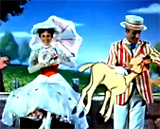 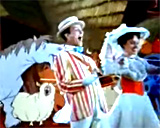 Live Action and Animation |
|||||||||||||||||||||||||||||||||||||||||||||||||||||||||||
|
Fantastic Voyage (1966)
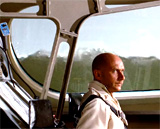
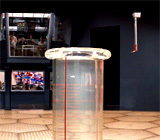
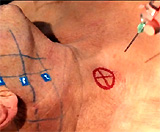
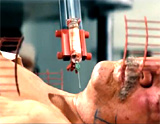
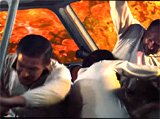
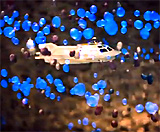
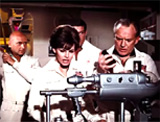
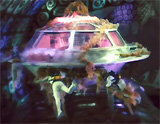
The film's basic 'fantastic' premise - a nearly-dead, injured defecting Communist scientist Dr. Jan Benes (Jean Del Val), whose life was threatened by a blood clot in his brain (after an assassination attempt leaving the LAX airport), was to be saved within one hour's time by a miniaturized team of specialists (four males and a female) engaged in a microscopic mission (after being injected into the bloodstream of Benes' body) - who were themselves inside a micro-sized, high-tech nuclear-powered submarine, the USS Proteus (full-sized in actuality - 41 1/2 feet in length, 23 feet wide, 15 feet high, and weighing 4 tons). There were also four smaller versions of the sub, ranging from one and one half inches to five feet in length. The submarine vessel was miniaturized to "about the size of a microbe" - before it was injected in the body; a POV shot from inside the vessel looked out to illustrate its shrinkage; and then the vessel was injected into the arterial bloodstream (via the carotid artery) - seen from various perspectives - in order to travel through the patient's arteries to the brain, to dissolve the clot with a laser beam. The reason to revive or cure the scientist was to learn his newly-discovered secret - to prolong the miniaturization process indefinitely, beyond 60 minutes.
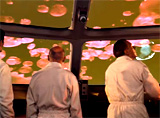
In terms of special effects, the interior of the scientist's body was created by using large, highly-detailed sets of various body parts or internal organs (i.e., the brain, the heart). There was a giant life-sized model of the interior circulatory system of the comatose patient, who was being monitored to precisely pinpoint the location of the submarine's 'fantastic voyage' inside of him. Through various techniques, the explorers were seen 'scuba-diving' (swimming) through the body's bloodstream (the actors were suspended on wires to create the illusion of swimming). The mission was to travel via the carotid artery to the location of the damage (the blood clot) - an attempt to dissolve the clot would be accomplished with a laser beam.
After becoming trapped in the venous system, the group decided to take a short cut through the heart, but needed to induce cardiac arrest for no more than 60 seconds to allow the submarine to detour through it - risking killing the patient; they had to stop the heart momentarily in order to prevent the sub from being crushed by thumping heartbeats. Then in order to replenish the sub's oxygen supply, American secret agent Charles Grant (Stephen Boyd) and the crew exited the sub and used a snorkel tube attached to the patient's lungs to force oxygen into the sub's tanks The crew discovered that the surgical laser that was to be used to perform the blood-clot procedure was damaged - it was not strapped down and become dislodged during turbulence - evidence of a enemy saboteur in the group that had tampered with it; it needed repair to its damaged transistor.
It was determined that the best way to proceed was to pass through the inner ear, it was imperative that exterior sounds be kept to a minimum. To clear the sub's clogged vents from seaweed-like antibodies in order to prevent the sub's overheating, another 'scuba-diving' trip was required to remove them. However, a destructive shock wave of vibrations was produced (during the vent-clearing mission) when one of the nurses accidentally dropped a pair of surgical scissors in the operating room - and the ship and all of its crew were violently jostled. In a memorable scene, curvaceous, 'scuba-diving' technical assistant Cora Peterson (Raquel Welch in her first major screen role) was thrown into some fibers due to the shock waves - causing damage and prompting antibodies to attack her body; the skittish Dr. Michaels warned: "If the antibodies reach her, they'll attack as if she were bacteria"; as she was brought back to the ship and through the reflooded airlock and into the ship, the antibodies continued to attack, and she screamed: ("They're tightening up - Please, I can't breathe"); the crew rescued her by groping her chest and throat and pulling the seaweed-like antibodies from her body as they crystallized.
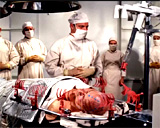
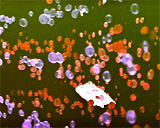
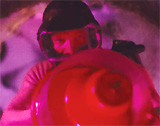
With only 12 minutes remaining, from the middle ear, the sub passed through the endolymphatic duct and back into the vascular system before it entered into the brain and the location of the clot. They came upon a "dark spot" - recognized by Dr. Duval (Arthur Kennedy) as the site of the injury that needed to be healed. The crew determined that it had only a total of six minutes to complete their mission before de-miniaturization began (four minutes to perform the blood clot operation with the laser and two minutes to get to the removal point); the crew was under tremendous pressure outside the ship to succeed. Once the operation to relieve the pressure was completed in about four minutes by Dr. Duval (with Cora and Grant), the mission was meanwhile being sabotaged by twitchy on-board crew member Dr. Michaels (Donald Pleasence) who wanted to abort the mission; he knocked out pilot Owens with a blow to the head, took control of the sub, and attempted to crash it at full speed into the clot area of fragile brain cells (the central nerve) to kill the patient. The remaining crew members were saved by heroic Commander Grant, who grabbed Duval's laser and shot at the high-tech sub to incapacitate it; after it was diverted and crashed into some dendrite tissue, puffy, jelly-fish like white corpuscles converged to envelope, consume, and digest both the submarine and Dr. Michaels who was physically pinned and trapped inside the bubble-dome. Before the Proteus was entirely injested, Grant returned to the Proteus to rescue Owens, and he watched as the saboteur Dr. Michaels was engulfed and suffocated by a gigantic white corpuscle (macrophage).
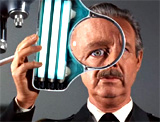
The four surviving crew hurriedly swam along the optic nerve and were able to emerge safely from the tear duct at the corner of the patient's right eye to be rescued - they were viewed in a magnifier and lifted out of the teardrop on a microscope slide by Col. Reid, and placed on the Zero Module in the Miniaturization Room just before they reverted back to normal size. |
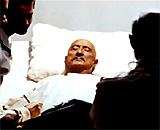 The Comatose Patient - Dr. Benes (Jean Del Val) 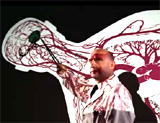 Dr. Michaels (Donald Pleasence) Pointing Out Artery (Red) Pathways on Projected Model Image 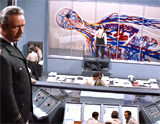 The Observation Room and Control Center 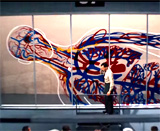 Monitoring and Tracking Location of Sub Within the Life-Sized Model  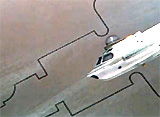 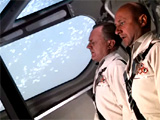 The Actual Injection 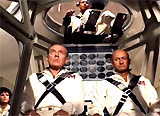  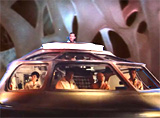 The Proteus Detouring Into and Through the Stopped Heart (Under Artificial Cardiac Arrest)  A Visualization of the Oxygenation Process  Passage Blocked and Slowed by Reticular Fibers in the Lymphatic System  Clanging Noise From Dropped Scissors Caused Massive Shock Wave in Inner Ear 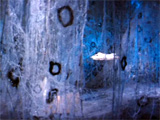 At the Base of the Human Brain 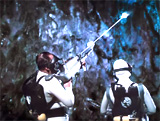 Dr. Duval Repairing the Brain's Blood Clot With Laser Beam 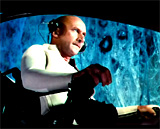 Dr. Michaels' Attempt to Sabotage Mission by Crashing Sub 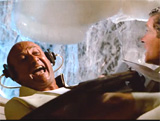 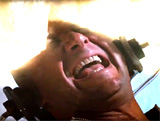 Dr. Michaels' Death Sequence - Consumed by White Corpuscles 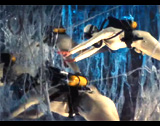 The Four Saved Crew Members Swimming Along the Optic Nerve to The Corner of the Eye |
|||||||||||||||||||||||||||||||||||||||||||||||||||||||||||
|
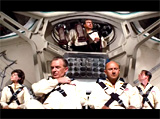
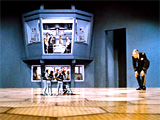
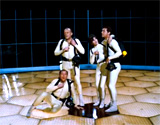
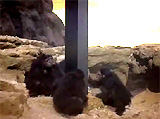
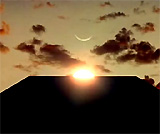
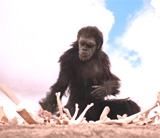
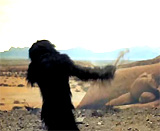
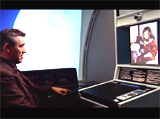
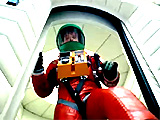
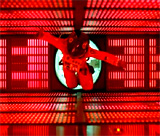
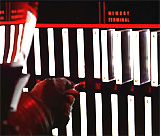
2001: A Space Odyssey (1968) In the film's opening "Dawn of Man" sequence of prehistoric apes in the year 4,000,000 BC learning to use tools on the African savannah, retroreflective matting (front projection) was used to display second-unit background scenic shots projected from the front onto a reflective surface combined with soundstage photography of actors in the foreground - a technique now replaced by computer-processed blue-screen techniques.
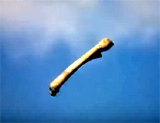
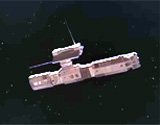
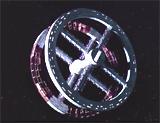
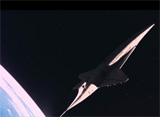
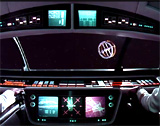
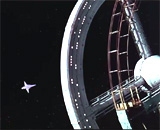
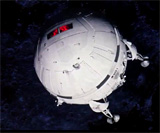
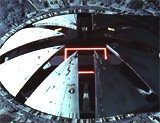
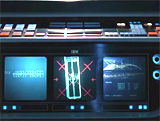
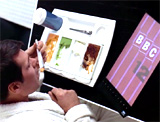
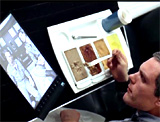
There was a marvelously audacious, seamless transition/edit of a deflected, flying skeleton bone-weapon from an ape-man - in slow-motion - turning into a futuristic, earth-orbiting space satellite (a tool or weapon?) - one of the most famous jump-cuts in cinematic history. Miniature models of spacecraft, timer or manually-guided pre-motion control cameras, rear-projection (for the film's many video displays and computer monitors), full-sized props or models (such as the 30-ton rotating "ferris wheel" set of the spaceship), and other early techniques (such as a primitive type of "Go-Motion") were used.
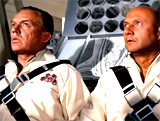
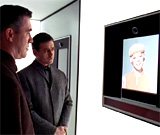
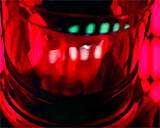
The Moon monolith sequence was followed 18 months later by a nine-month, manned voyage of the spaceship Discovery on a half billion-mile journey to Jupiter; on board was an omniscient but faulty HAL 9000 computer (voice of Douglas Rain) identified by a 'red eye', and two astronauts who were not in hibernation: Frank Poole (Gary Lockwood) and David Bowman (Keir Dullea); three astronauts were in cold-storage suspended animation. In one of the film's best scenes, the HAL 9000 computer malevolently eavesdropped by reading the lips of the astronauts as they privately spoke to each other in a sound-proofed, sealed space pod, discussing how HAL had become unreliable and irrational regarding his prediction of a faulty AE35 antenna unit. Three further instances proved that HAL was planning to sabotage the mission:
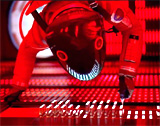
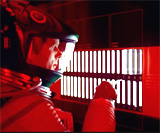
Then to retaliate against HAL, Bowman took a slow walk to the computer's reddish-toned "brain room" to slowly debrain and disconnect the computer's core (he performed a mechanical lobotomy on the computer's logic and memory circuits).
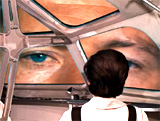
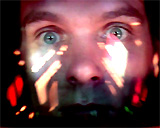
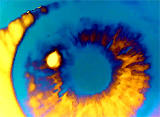
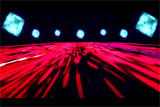
Astronaut Bowman continued his flight to Jupiter - he encountered a third much larger monolith circling Jupiter amongst Jupiter's other moons; the giant planet Jupiter (lit up as a bright crescent shape) and its many moons, the spaceship Discovery, and the Sun lined up with this third monolith. Near the film's end in the Star Gate sequence, astronaut David Bowman traveled through the stargate corridor in a dazzling sequence (using a slit-scan photographic technique) - a sound and light hallucinatory journey or whirling lights and colors in which he was hurled through and into another dimension. Some of the effects were achieved by applying different colored filters to aerial landscape footage and a close-up of an eye, and filming interacting chemicals.
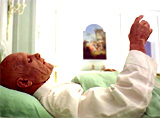
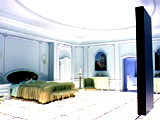
In an enigmatic sequence, the astronaut's space pod landed and came to a halt somewhere beyond Jupiter in semi-familiar surroundings created out of his own subconscious memories by the aliens; in the surrealistic conclusion of the film, the pod came to rest in a decorated, light-green and glacially-white 'cosmic bedroom' or ornate Victorian hotel suite/bedroom chamber; Bowman emerged from the space capsule, and saw himself as he drastically aged through various stages of life; on his deathbed, Bowman looked toward the foot of his bed and pointed at the film's fourth giant black monolith in the center of the room.
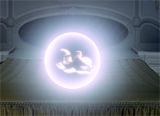
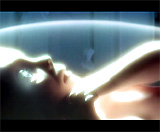
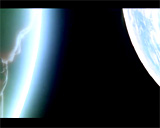
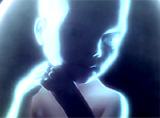
As Bowman reached out to the monolith, the camera moved toward the blackness of the monolith and he was seemingly reborn (or evolved/transcended) into an ambiguous Star Child -- a fetus that was floating above the Earth in an orb of light.
|
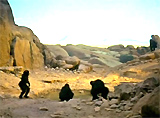 "Dawn of Man" 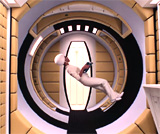 Rotational Elevator on Spaceship Aries to Moon - Trick Photography 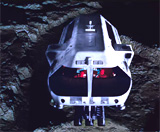 Moon Bus to Crater - Site of Monolith 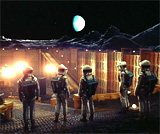 Excavated Crater on Moon with Lit-Up Monolith 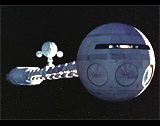 Discovery 18 Months Later On a Mission to Jupiter  Astronaut Poole Jogging Inside Discovery  HAL-9000s Ubiquitous Glowing, Watchful Red Eye 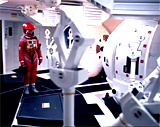 Props and Models in the Space Pod Room Inside Discovery 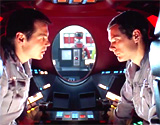  HAL Listening to Two Scheming Astronauts Through Lip-Reading 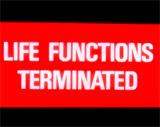 Hibernating Crew Members Killed by HAL 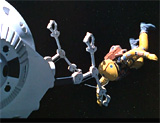 Bowman's Vain Attempt in a Pod to Rescue Poole in After His Oxygen Had Been Cut by HAL 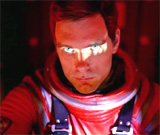 Bowman: "Open the pod bay doors, HAL" 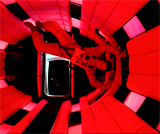 Bowman Blasting Himself Back Into Air-Lock  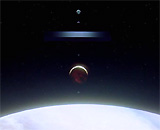 On Bowman's Way to Jupiter - Alignment of Planets, Moons, and 3rd Monolith 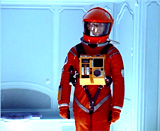 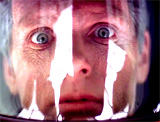 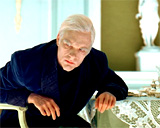 Bowman Gray-Haired and Aging |
|||||||||||||||||||||||||||||||||||||||||||||||||||||||||||

|
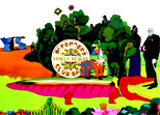
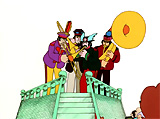
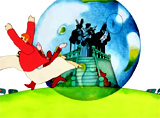
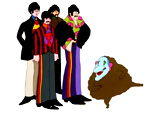
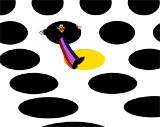
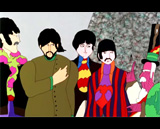
The Yellow Submarine (1968, UK) Director George Dunning's landmark, trippy animated film featured many colorful, inventive animations. Its story was about the Beatles accompanying Admiral Fred in his Yellow Submarine to venture back to Pepperland to defeat the music-hating Blue Meanies. Pepperland was portrayed as a paradisical land 80,000 Leagues Under the Sea - a happy, colorful, peaceful, music-loving kingdom. On an elevated bandstand, the 4-member Sgt. Pepper's Lonely Hearts Club Band (resembling the four Beatles) played in a concert for the members of the Kingdom.
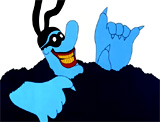
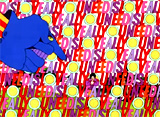
The Blue Meanies, led by Chief Blue Meanie and his henchman Max, lived closeby beyond the mountains and were planning to invade and put an end to Sgt. Pepper's Pepperland. They had various devices, such as Apple Bonkers (with Huge Green Apples), Splotch Guns, Dreadful Flying Gloves (that turned residents into stone with pointed fingers), and Anti-Music Missiles to eliminate Pepperland by immobilizing everyone and taking away color and turning everything grey.
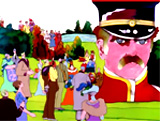
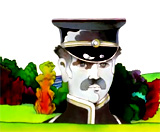
As an attack occurred, uniformed Young Fred - who was appointed Admiral by the elderly Lord Mayor at the base of the platform holding Pepperland's Yellow Submarine, was sent off to seek help in the surface world. He journeyed to Liverpool, England, to retrieve the four Beatles (Ringo, John, Paul, and George) to return with him in the submarine back to Pepperland to save the land.
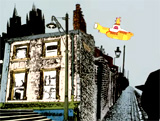
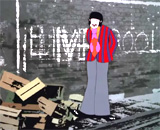
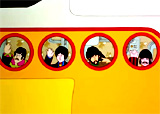
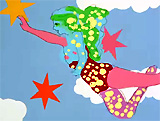
Once the submarine arrived in post-war England, it traveled over a depressed, industrialized, gray land, as the song "Eleanor Rigby" played - about loneliness and the elderly ("Ah, look at all the lonely people"). Ringo (of the Beatles) was located in Liverpool, before all four Beatles were located. They joined Young Fred in the submarine - each one viewed in one of the sub's portholes. During the submarine journey back (a "modyssey") when they went under the waves, and singing "All Together Now," the group encountered various strange worlds, including the Sea of Time, the Sea of Science, the Sea of Monsters, the Sea of Nothing, the Sea of Green, and the Sea of Holes. In the Sea of Time, time flowed both forwards and backwards (the song "When I'm Sixty-Four") - illustrated by the psychedelic count of numbers to demonstrate the length of a 60-second minute. In the Sea of Nothing, they met poetry-spouting Jeremy Hillary Boob Ph.D. - a short and studious creature (the song "Nowhere Man") who was muttering to himself: "Ad hoc, ad hoc, and quid pro quo, So little time, so much to know." Shortly later, in the Foothills of the Headlands, they sang about "Lucy in the Sky with Diamonds" accompanied by glittering and glowing fantastical imagery - some thought it was an oblique reference to an LSD-inspired hallucinogenic trip.
After returning to Pepperland, the Lord Mayor was revived and the Beatles disguised themselves and dressed up as members of the Sgt. Pepper's Lonely Hearts Club Band, and also stole some instruments. They were able, through music ("All You Need Is Love"), to defeat the Dreadful Flying Glove, unfreeze the inhabitants, and bring the return of color and blooming flowers that ended the assault of the invasive Blue Meanies. The Chief Blue Meanie was transformed by the Boob's poetry and bloomed pink roses on his body as he realized he was defeated - he bemoaned: "It's no longer a blue world. Where can we go?" He realized that he must join the happy musical group.
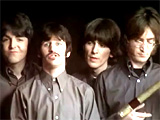
The live-action finale featured the actual Beatles after restoring love, life, color, and happiness. As a warning while looking through his spyglass, however, John noted: "Newer and bluer Meanies have been sighted within the vicinity of this theatre" and urged everyone to sing "All Together Now." He added: "There is only one way to go out... Singing!" The film ended with translations of the song's title into various languages.
|
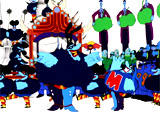 The Blue Meanies (Led by the Chief) Plotting to Destroy Pepperland 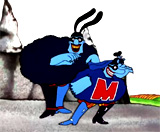 Chief Blue Meanie and Max 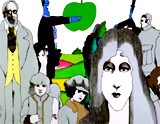 Attack of Apple Bonkers With Green Apples 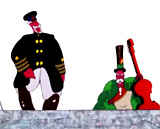 Young Fred Appointed Admiral by edlerly Lord Mayor  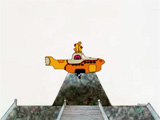 Yellow Submarine to the Rescue 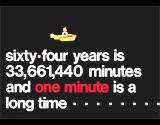  "When I'm 64" 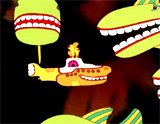 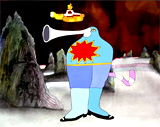 Sea of Monsters - with a Vacuum Thrask 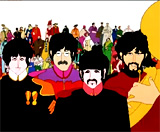 The Restoration of Color and Happiness 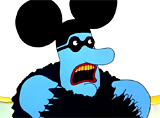 Flight of the Blue Meanies 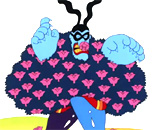  Defeat of the Chief Blue Meanie |
|||||||||||||||||||||||||||||||||||||||||||||||||||||||||||




 This
film was the first winner of the newly-named Academy Award for FX - Best
Achievement in Special Visual Effects. (After 1963, the category
was split into two: Best Special Visual Effects and Best Sound Effects.)
This
film was the first winner of the newly-named Academy Award for FX - Best
Achievement in Special Visual Effects. (After 1963, the category
was split into two: Best Special Visual Effects and Best Sound Effects.)