|
Special Effects (F/X) - Milestones in Film 1992-1994 |
|
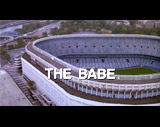
The Babe (1992) Director Arthur Hiller's inaccurate and superficial biographical film was about legendary baseball player George Herman "Babe" Ruth, portrayed by John Goodman. Babe played baseball for 22 seasons, from 1914 through 1935. There have always been unfounded or inaccurate stories about the "Babe," including these unfounded elements portrayed in the biopic, although the film vowed in its prologue: "The following incidents are based on true events that occurred between 1902 and 1935."
Since star John Goodman was right-handed and he was portraying left-handed, legendary baseball player "Babe" Ruth, film-makers composited Goodman with a left-handed pitcher in action to get the fast-ball scene accurately shot. Also, to save money and time by using extras, the baseball park was filled by shooting just one section of extras and then wallpapering the stands with copies of them. The film became one of the first to use CGI to generate large crowd shots. |
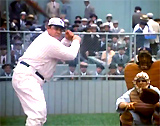 Actor Goodman Portrayed as Left-Handed 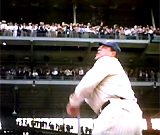 Wallpapering in Crowds in Stands  Babe Pointing to Dugout |
||||||||||||||||||||
|
Death Becomes Her (1992)
It told about two narcissistic rival women, both of whom attained eternal youth through a rejuvenating magic tonic:
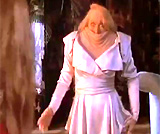
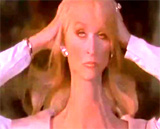
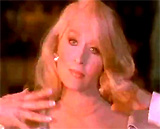
The film featured photo-realistic skin (created with the first human skin CG software) - skin was replicated to link a body and head together with a digital neck, and then digitally retouched. Its two taglines thoroughly explained the plot:
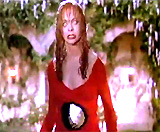
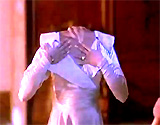
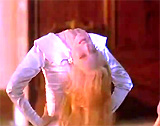
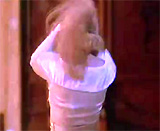
The extensive CGI effects were in the scenes of both undead females dying and surviving various attempts on their lives:
|
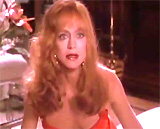
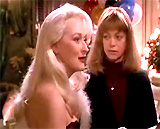 (l to r): Madeline and Helen - Best Friends and Rivals 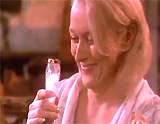 Madeline's Purchase of Rejuvenating Potion 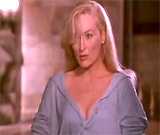 Madeline's Perky Breasts After Drinking Potion 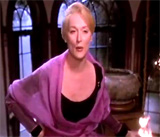 Madeline - Before Suffering a Twisted Head 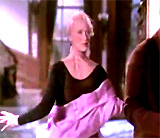 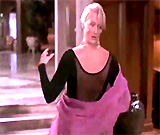 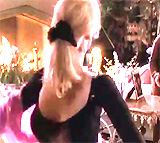 Madeline - Her Twisted Head (After She Tumbled Down the Stairs) 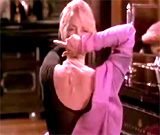 Madeline - Attempting To Twist Her Head Back Around 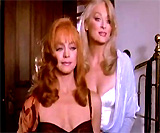 The Two Crazed, Undead Females 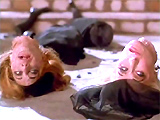
Conclusion: Madeline's and Helen's Disembodied Heads |
||||||||||||||||||||
|
The Lawnmower Man (1992) This breakthrough film was a science-fiction, horror-thriller loosely derived from Stephen King's 1975 short story, and directed by Brett Leonard. It contained ground-breaking special effects - and introduced a computer-generated Virtual Reality to films. [Note: Director Leonard's next virtual-reality film was Virtuosity (1995).] It was the first feature film in the 1990s to use ground-breaking computer animation to explore the subject of virtual reality. It used motion capture, particle systems, algorithmic-based paint, and other state-of-the-art techniques running on SGI workstations, to create the VR effects. It was also one of the first films to record a human actor's movements in a sensor-covered body suit - a technique called Body Motion Capture, to control the movements of a CG character.
There was one imaginative and surreal CGI sequence (8 minutes in length) of virtual reality sex (or cybersex), the first of its kind, between:
Both wore bodysuits, gloves, and head-mounted displays (HMDs), and were strapped into huge gyroscopes - all connected to the computer. After they kissed, the two intertwining lovers became swirling liquid metal, fusing with one another. The couple took the form of two metallic insects looking like a two-headed dragonfly - flying as one being. Jobe took over the dual fantasy, claiming to know what was in Marnie's mind, but she became trapped in the scary world of his avatar and then was traumatized when he attacked her mind (Marnie: "Oh my God, let me out"). Her brain patterns became irregular, signifying that she had become a brain-dead vegetable. In the film's VR climax, now all-powerful and angrier Cyber-Being Jobe Smith shed his body and entered into the computer's main-frame at Dr. Lawrence Angelo's (Pierce Brosnan) lab at Virtual Space Industries. Jobe's goal was to become a wholly virtual being of "pure energy". He described his psychotic objective, to become Cyber-Christ:
In the virtual world, he realized he couldn't find a way out when Dr. Angelo trapped him inside. He then faced off against Dr. Angelo who also entered the cyber-reality, who crucified him for a time. Jobe eventually allowed Dr. Angelo to escape from the virtual world back into the physical world - and from the lab building, which had been planted with explosives. When Jobe found a 'back-door' and entered the lab building, his physical body appeared obliterated by the blasts. Dr. Angelo narrated (partly in voice-over):
The film ended ominously - however, with phones ringing everywhere around the world. |
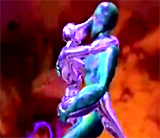 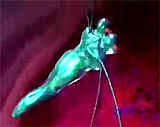 Cyber-Sex Sequence 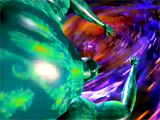 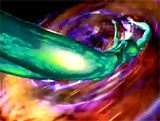 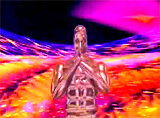 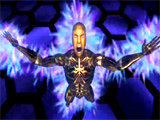 Entering Into Neural Network 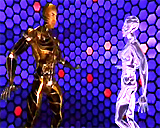 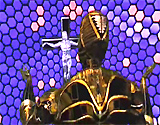 Jobe vs. Dr. Angelo |
||||||||||||||||||||
|
The Muppet Christmas Carol (1992) Director Brian Henson's fantasy musical (his directorial debut film, the son of Jim Henson) was the first major Muppet project after the death of puppeteer creator Jim Henson. It was the fourth feature film to star the Muppets. It was a telling of Charles Dickens' seasonal tale with the Muppet characters - and actor Michael Caine as miserly, 19th century London businessman Ebenezer Scrooge. It was the first feature film to use a green screen instead of a blue screen for its visual effects, allowing for filming against a rich blue night sky in the Ghost of Christmas Past sequence. At the stroke of 1 o'clock AM, Scrooge was visited by the Ghost of Christmas Past, and then taken by the hand and flown over the London cityscape, to revisit his past. The flight over London was achieved with a combination of blue-screened footage of Scrooge in a wire harness and the same intricate London models used for the film’s opening titles.
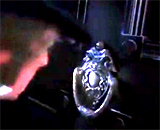
The film also featured minor morphing effects with the knocker transforming into the head of Marley, one of Scrooge's ex-business partners.
|
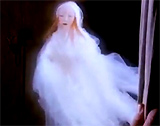 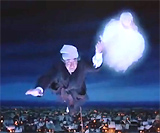 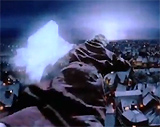 The Ghost of Christmas Past |
||||||||||||||||||||

|
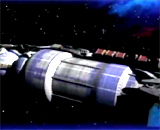
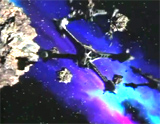
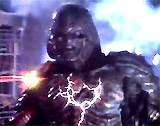
Babylon 5 (1993 and later) This sci-fi TV series was first piloted as a TV movie titled Babylon 5: The Gathering, in February of 1993. After a successful launch, it began airing as a series in 1994, running for five full seasons (with 110 episodes). It was the first TV series to use CGI as its primary means to create special effects. It produced amazing scenes in outer space (a colorful-looking universe) without traditional miniature models or cameras. All of the special and visual effects were entirely computer-generated - created or produced with off-the-shelf micro-computer systems. Even effects like laser-blasts and matted-in backgrounds were done with computer art, with rich multi-layered textures and design. There were about 16 standing production sets that could be ingeniously modified with various dressings and lighting to simulate over 40 different locations. |
|
||||||||||||||||||||
|
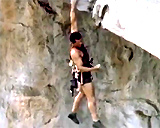
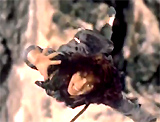
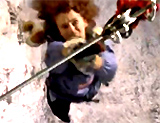
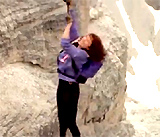
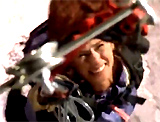
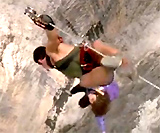
Cliffhanger (1993) Director Renny Harlin's Alpine action-adventure film employed a variety of special effects (miniatures, paintings and CGI) that were interwoven together with location footage, to seamlessly bring together the live action (in Italy's rugged Dolomite Mountains) and the optically-enhanced photography. A computer-controlled, 60-foot-high elevator rig with a mounted camera was an essential piece of equipment for some of the thrilling mountain shots. In various dangerous climbing sequences including the opening credits sequence, actor Sylvester Stallone (as climber and mountain rescuer Gabe Walker) was clearly seen hanging suspended from a rock face with his left hand gripping a ledge above him. To protect him in case he slipped, an eighth of an inch-diameter cable held him - and was later digitally erased. Then as a helicopter dropped over him and there was a pull-back shot, he was seen as a tiny figure climbing up to a ledge where two stranded climbers were located. During that transition, a stunt double (Wolfgang Gullich) was invisibly inserted or cut in (through a motion control system) for the actor.
In the film's tensest sequence, climber Sarah (Michelle Joyner) appeared to be hanging 8,000 feet above an abyss below. The illusion was created with three tricks:
Intricate miniature models were also used for aircraft that crashed or exploded in mid-flight, and were maneuvered with cables or hidden armatures. There was even a motorized, small-sized 16 inch long Stallone puppet constructed and used in the finale when the chopper fell off the cliff. However, the plane-to-plane airborne transfer stunt performed by Simon Crane at an altitude of 15,000 ft was done without special effects -- and noted as the costliest aerial stunt ever performed by the Guinness Book of World Records. |
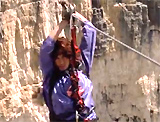 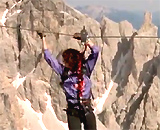     The Tense Wire Sequence 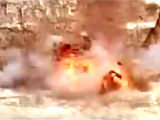 Helicopter Crash - Miniature Model |
||||||||||||||||||||
|
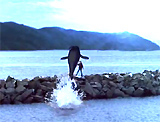
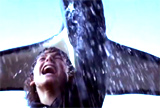
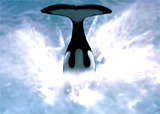
Free Willy (1993) Keiko, a killer whale, was the star orca Willy, in this family drama from Warner Bros. It was followed by three popular sequels:
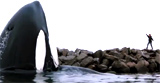
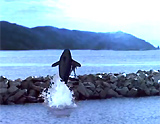
Although it appeared that the many live sequences involving Willy swimming in the open water were composed of actual footage, there was considerable use of an animatronic stand-in for Willy. And rather than train a real whale to leap to freedom in the open seas in the film's climax, a CG whale was inserted between shots of an animatronic Willy. One of the unintended side-effects of the film was a growing movement by activists and fans to free Keiko - and all similar killer whales from captivity. |
|
||||||||||||||||||||

|
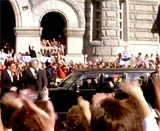
In the Line of Fire (1993) Director Wolfgang Petersen's political action thriller contained very expensive special effects. They were estimated to cost as much as 10% of the movie's $40-million production budget. The plot line was about a Secret Service agent who had failed to prevent the assassination of John F. Kennedy in 1963, and now 30 years later was attempting to stop another Presidential assassination. It was much cheaper to use footage from the 1992 political campaign than to pay extras to rally. Footage during a Clinton political rally, and of George Bush on the tarmac at Andrews Air Force Base was reused. Computers digitally retouched the images and replaced Bill Clinton and George Bush with the 'faceless' and fictional president (un-named but called Traveler) (Jim Curley) that aging agent Frank Horrigan (Clint Eastwood) was protecting. Horrigan was tracking a current would-be presidential assassin named Mitch Leary (John Malkovich). The face of actor Curley was digitally superimposed over Bush's and Clinton's.
Near the presidential candidates, agent Horrigan was also visible - he was seen scanning the crowd for possible assassins - an image that was matted in. Other objects, like campaign placards, were masked or disguised (the word Bush on campaign signs was replaced with the words Re-Elect the President). The Clinton rallies were made to look bigger and more raucous with the creation of computer-generated extras. There was, however, an actual Presidential motorcade shot in the streets of Washington, with agent Horrigan running alongside the limousine. In an early scene, Horrigan investigated an apartment, and found a wall with a collage of photographs and newspaper clippings about the John F. Kennedy assassination. In this scene was another digital effect - an image of Clint Eastwood's character "Dirty Harry" Callahan from his earlier film Dirty Harry (1971) was dropped in and then matched or implanted into a picture taken of JFK's and Jackie's 1963 Dallas airport arrival at Love Field on the day the president was assassinated. However, Eastwood's image was made to look even younger (he was given a digital haircut with shaved off sideburns, his tie was narrowed, and his jacket was given a digital lapel). During the next visit to the apartment, they found a solitary photo of the Kennedy motorcade in Dallas with Frank circled in red. In another effect, computer graphics (rather than a miniature model) simulated the presidential jet Air Force One, during a nighttime establishing shot when it was flying through a rainstorm. |
 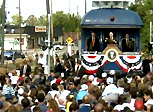 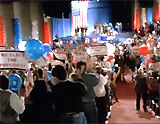 Retouched Rally Crowd Scenes 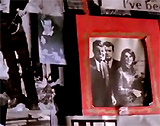 Collage of Items About JFK Assassination 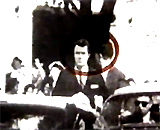 Kennedy's Dallas Motorcade (with Frank Inserted Into Picture) 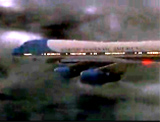 Air Force One - CGI |
||||||||||||||||||||
 |
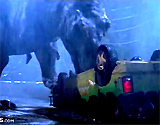
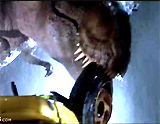
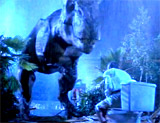
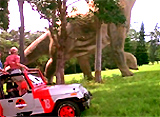
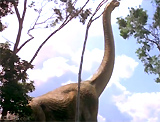
It mixed animatronic models and computer-generated (CGI), photo-realistic dinosaurs, displayed with textured skin and muscles. It marked the first use of photo-realistic, CG creatures in a feature film. The CGI creatures were artificially-generated at Industrial Light & Magic (ILM) and very realistically-rendered and seamlessly integrated within live-action sequences. There were 14 minutes of dinosaur footage in the movie, with only four of those minutes generated by computers. It had a grand total of 75 visual effects shots - a large number for its time. The original plan to use stop-motion versions of dinosaurs was quickly scrapped when CGI became the better option. It was the first major instance of extensively having computer-generated animated characters mixed with live action. One of the most lauded special effects scenes of all-time was the one that revealed the brachiosaurus standing on its hind legs, and eating from tree tops. The scenes of the living, eating, and breathing dinosaurs (including the scene of the stampeding herd of Gallimimus) also used mechanical animatronic robots and miniature models in stop-motion, frame-by-frame processing. The T. Rex was shot using 20- and 40- foot tall animatronics. The 20 foot-tall model weighed over 13,000 pounds. There were a few scenes involving the night-time attack of the T. Rex, first on a jeep, and then on a lawyer cowering in a toilet. They used live action and digitization in the toilet sequence - the first example of a computer-generated human stunt double, involving hyper-realistic rendering.
Other models included a Triceratops and Dilophosaurus. As well as CGI and animatronics, the Velociraptors were also men dressed in rubber suits.
|
  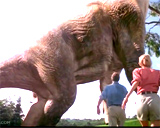 Brachiosaurus Eating Tree Tops 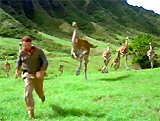 Stampeding Herd of Gallimimus to Flee T-Rex 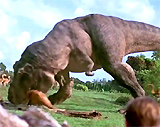 T-Rex Attacking One Gallimimus |
||||||||||||||||||||
|
The Nightmare Before Christmas (1993) Producer Tim Burton's masterpiece (the film was directed by Burton's colleague at Disney Animation, Henry Selick) used sophisticated computer-controlled cameras to execute state-of-the-art camera movement for this feature film's stop-motion animation. The stop-motion film was directly inspired by the Rankin/Bass Productions animated Christmas TV specials, such as Rudolph, The Red-Nosed Reindeer (1964) or Santa Claus Is Comin' To Town (1970). There were over 100 specially trained camera operators, puppet makers, set builders, and prop makers. There were 13 animators, 8 camera crews, and 4 sculptors. Puppets (built of a foam latex material covering intricate metal armatures to allow for flexible movement) were manipulated frame-by-frame on real miniature sets. There were a total of 19 sound stages, comprising 230 model sets. There are as many as 60 individual characters, with three or four duplicates each. To allow for different emotions of the main character Jack Skellington, he alone had 700 heads. The other main character Sally had a mask for every one of her expression changes. The painstaking film took nearly three years to complete (dozens of animators and crew members averaged only 60 seconds of film per week), because each different pose or position equaled a 24th of a second. The animators had to create unique motions for a total of 110,000 frames. Burton rejected the idea of a CGI sequel for the film. |
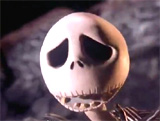 Jack Skellington (The Pumpkin King) 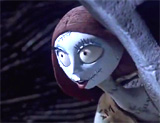 Rag-Doll Sally 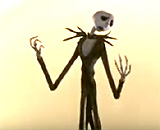 Jack Expressive Torch Song: "Jack's Lament" ("...Oh, somewhere deep inside of these bones / An emptiness began to grow..." ) |
||||||||||||||||||||
|
The Crow (1994) Director Alex Proyas' dark action/drama employed 52 special effects shots for the entire film, 7 that involved the late actor Brandon Lee. He was the first dead actor to be re-created with CGI. Those seven shots of Lee (created by the VFX company Dream Quest Images) comprised only about 30 seconds in the two-hour movie. Miramax celebrated the film's success at the time - it marked their biggest opening ever, and was the # 1 hit during its first weekend. 28 year-old Lee was unexpectedly and tragically killed on the set just before filming was completed. The scene in which he lost his life was the opening apartment murder sequence when Funboy (Michael Massee) fired a .44 Magnum revolver at Eric as he entered the room.
Because seven more scenes with Brandon still needed to be shot, a body-double (stuntman Chad Stahelski) stood in for the missing actor - with Lee's face digitally-painted (or composited) on, and other scenes were manipulated. It was almost impossible to tell which scenes were with the real Brandon Lee, and which ones were post-humously created. The scenes that were completed after Lee's death - usually to use CGI to paint on Lee's face, included:
The film opened with the prologue (voice-over), delivered by Sarah (Rochelle Davis), a friend in the neighborhood:
In the film's story, just one day before his wedding on Halloween Day in Detroit, Michigan to Shelly Webster (Sofia Shinas), local musician and guitarist Eric Draven (Brandon Lee) was murdered by stabbing, a gunshot, and a toss out the apartment window. His fiancee was also raped and seriously beaten, and later passed away. As the prologue described, one year later, a crow landed on Eric's headstone - and awakened his interred corpse in the grave by tapping its beak on the headstone. Eric arose from the ground - with a mission to seek vengeance against the street gang that eliminated him and Shelly. |
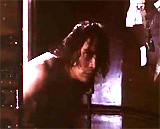 Draven Entering Apartment Doorway 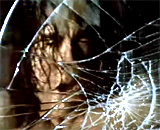 Reflection Shot in Broken Mirror 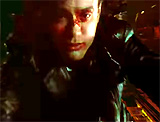 Backward Fall Through the Window 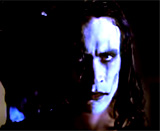 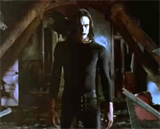 Walking To Window With Crow on Shoulder - Face Was Visible During Lightning Flashes As the Camera Pulled Backward |
||||||||||||||||||||
|
The Flintstones (1994) This live-action film, based upon the 1960s Hanna-Barbera animated TV sit-com, featured the first instance in a feature film of digital fur or hair rendering - on saber-tooth tiger "Kitty" or Baby Puss - the Flintstones' family cat. The film ended with Fred Flintstone (John Goodman) attempting to put the cat out, but was put out himself. |
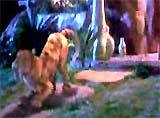
Digital Fur on "Kitty" |
||||||||||||||||||||
|
Forrest Gump (1994)
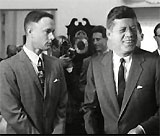
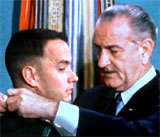
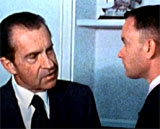
The film's remarkable effects, similar to those in Woody Allen's mockumentary Zelig (1983), included Forrest Gump's (Tom Hanks) digitally-composited interplay with historic events (Governor Wallace's standoff in Little Rock, AK), and his meeting with three past Presidents (Kennedy, Johnson and Nixon) and other celebrities (Elvis Presley, John Lennon).
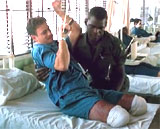
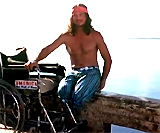
Vietnam vet double-amputee Lt. Dan Taylor's (Gary Sinise) lower legs were removed by wrapping his lower extremities with blue-screen fabric.
Gump also played a remarkable game of Ping Pong (with a digitized ball and crowd watching) in China. Crowd scenes (in the football stadium, and in the political rally in DC) used a replication special-effects technique. And the fluttering feather in the film's opening and conclusion was actually attached to a string (that was later erased). |
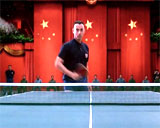 Ping Pong Game 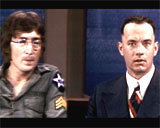 Forrest On The Dick Cavett Show With John Lennon 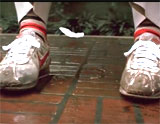 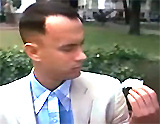 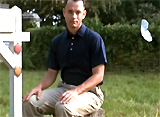 Dancing Feather in Opening and Closing |
||||||||||||||||||||

|
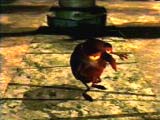
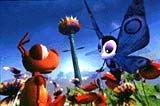
Insektors (1994) This TV series was the first completely computer-animated (CGI) cartoon series to be broadcast. It was created by a small French studio known as Fantome. It first aired in France, and was then dubbed into English for US and UK television. Its appearance was only a few months before another completely-CG animated cartoon TV series was aired - the full-length Canadian action-adventure series called ReBoot (1994). It told about two warring anthropomorphic tribes of insects:
|
   |
||||||||||||||||||||
|
The Lion King (1994) The original animated feature film (in a long-running series of sequels, both direct-to-video and TV series/specials) was Disney's immensely popular and successful adventure-drama about a pride of lions in Africa. The operatic story was about king-to-be lion cub Simba (voice of Jonathan Taylor Thomas), whose father Mufasa (voice of James Earl Jones) was murdered by Simba’s villainous uncle Scar (voice of Jeremy Irons). Its plot, although loosely based upon Shakespeare's Hamlet, was the first Disney animated film to feature a completely original storyline. It was the second highest-grossing film (domestic) of the year. To create the real look and feel of wildlife in Africa, the characters were not anthropomorphized. Along with traditional animation techniques, computer animation was used in a few of the scenes, including:
It was a remarkable blend of 3-D computer animation and traditional animation that took more than two years to complete. Crowds of 3D animated wildebeests were integrated into painted backgrounds. A few distinct wildebeest characters were drawn in a 3D computer program (with cel shading), and then multiplied to give the impression of a large herd that was wildly stampeding down a mountainside. The creation of the scene involved writing a new computer program to govern the movements of the herd. |
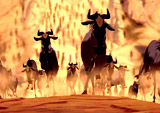 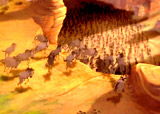
The Wildebeest Stampede Sequence |
||||||||||||||||||||
|
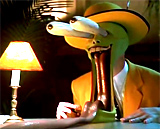
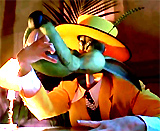
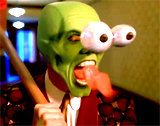
The Mask (1994) Director Chuck Russell's superhero action comedy was about an ancient, magical Mask of Loki - that turned its wearer into an uninhibited, hyperactive, super-hero trickster known as The Mask - a cartoonish character wearing a zoot-suit, and possessing a green face. His antics became zany, his face became flexible and rubbery, and he acquired super-human powers. This film combined live-action with animations composited onto the frame - (the Mask itself, a balloon transformed into a cartoon-styled tommy gun, etc.). This marked the first instance of visual effects artists (at ILM and Digital Domain) turning a live actor into a photo-real cartoon character, or the first film that blended live action with CGI for human effects.
The lead character, comedy super-star Jim Carrey, was made to appear like the hyperactive cartoon characters of Tex Avery during the golden age of animation, especially in the scene when he wolf-whistled at a pretty woman and his eyes bugged or popped out - looking like the wolf from MGM's and Avery's Red Hot Riding Hood (1943) cartoon. |
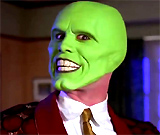 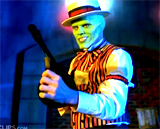 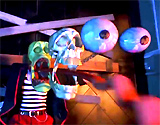 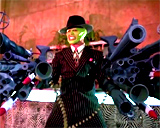 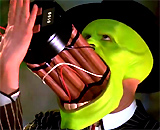
Live-Action and CGI- Effects Blended Together |
||||||||||||||||||||
 
|
ReBoot (1994- , Canada) The first 100% CGI children's TV series, titled ReBoot, aired on ABC, presented by Mainframe Entertainment Inc. (with a team of 70 animators). It debuted on North American screens over a year before Toy Story (1995). There were 47 30-minute episodes over a few seasons. One season of ReBoot episodes (16 shows) meant producing almost 320 minutes of CGI. The making of each episode required computer power, provided by Silicon Graphics high-end workstations.
The story was about a multi-level city inside a PC computer, dubbed Mainframe. The city's inhabitants included:
They battled against threats presented by two villainous viruses, code masters, and other computer-associated enemies who wanted to take over the network:
|
 Mainframe 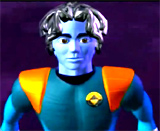 Guardian Bob 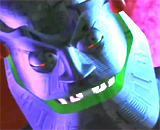 Megabyte 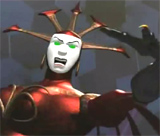 Hexadecimal |
||||||||||||||||||||




 Director
Robert Zemeckis' black comedy-fantasy was the Academy
Award winner for Best Achievement in Visual Effects. The Univeral Pictures'
film employed extensive ILM special effects (CGI digital effects as
well as prosthetics, miniatures, blue screen work, and animatronic
puppets) to tell its story, and defeated two other Oscar contenders:
Director
Robert Zemeckis' black comedy-fantasy was the Academy
Award winner for Best Achievement in Visual Effects. The Univeral Pictures'
film employed extensive ILM special effects (CGI digital effects as
well as prosthetics, miniatures, blue screen work, and animatronic
puppets) to tell its story, and defeated two other Oscar contenders: