|
Innovations Necessary for the Advent of Cinema:
Optical toys, shadow shows, 'magic lanterns,' and visual
tricks have existed for thousands of years. Many inventors, scientists,
and manufacturers have observed the visual phenomenon
that a series of individual still pictures set into motion created
the illusion of movement - a concept termed persistence of vision.
This illusion of motion was first described by British physician Peter
Mark Roget in 1824, and was a first step in the development of the
cinema.
A number of technologies, simple optical toys and mechanical inventions related to motion
and vision were developed in the early to late 19th century that were
precursors to the birth of the motion picture industry:
- [A very early version of a "magic lantern"
was suggested in the mid-17th century by German Jesuit priest
Athanasius Kircher in Rome. However, the official inventor
of a usable device was prominent Dutch astronomer/scientist
Christiaan Huygens in the 1650s. Like a modern slide projector
(which has since gone out of date!), its main feature was a
lens that projected images from transparencies onto a screen,
with a simple light source (such as a candle).]
- 1824 - the invention of the Thaumatrope (the
earliest version of an optical illusion toy that exploited the concept
of "persistence of vision" first presented by Peter Mark Roget in a scholarly article) by an English doctor named Dr. John Ayrton Paris
- ca. 1826 or 1827 - the oldest recorded
(and surviving) permanent photograph made in a camera was taken
by French inventor Joseph Nicéphore Niépce. He used
a camera obscura device which captured and projected a
scene illuminated by sunlight. The photo image was "shot" at his
estate named Le Gras from his studio's upstairs window in the Burgundy
region of France in the early 1820s. It
was a very rudimentary photograph (using principles of lithography)
- the image is now known as View
from the Window at Le Gras. His invention was called heliography,
or "light
writing."
- 1831 - the discovery of the law of electromagnetic
induction by English scientist Michael Faraday, a principle used
in generating electricity and powering motors and other machines (including
film equipment)
- 1832 - the invention of the Fantascope (also
called Phenakistiscope or "spindle viewer") by
Belgian inventor Joseph Plateau, a pre-film animation tool
that simulated motion. A series or sequence of separate pictures
depicting stages of an activity, such as juggling or dancing,
were arranged around the perimeter or edges of a slotted disk.
When the disk was placed before a mirror and spun or rotated,
a
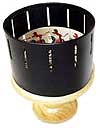 spectator
looking through the slots 'perceived' a moving picture. spectator
looking through the slots 'perceived' a moving picture.
- 1834 - the invention and patenting of another stroboscopic device adaptation, the Daedalum (renamed the Zoetrope
in 1867 by American William Lincoln) by British inventor William George
Horner. It was a hollow, rotating drum/cylinder with a crank, with a
strip of sequential photographs, drawings, paintings or illustrations on the interior surface and regularly
spaced narrow slits through which a spectator observed the 'moving' drawings.
- 1839 - the birth of still photography with the development
of the first commercially-viable daguerreotype (a method
of capturing still images on silvered, copper-metal plates) by
French painter and inventor Louis-Jacques-Mande Daguerre, following
on the work of Joseph Nicéphore Niépce. It was the
first commercially-available, mass-market means of taking photographs.
- 1841 - the patenting of calotype (or Talbotype,
a process for printing negative photographs on high-quality paper) by
British inventor William Henry Fox Talbot
- 1861 - the invention of the Kinematoscope, patented by Philadelphian Coleman Sellers, an improved rotating paddle machine to view (by hand-cranking) a series of stereoscopic still pictures on glass plates that were sequentially mounted in a cabinet-box
- 1869 - the development of celluloid by John
Wesley Hyatt, patented in 1870 and trademarked in 1873 - later used
as the base for photographic film
- 1870 - the first demonstration of the Phasmotrope (or Phasmatrope) by Henry Renno Heyl in Philadelphia, that showed a rapid succession of still or posed photographs of dancers, giving the illusion of motion
- 1877 - the invention of the Praxinoscope by
French inventor Charles Emile Reynaud - it was a 'projector' device
with a mirrored drum that created the illusion of movement with picture
strips, a refined version of the Zoetrope with mirrors at the center
of the drum instead of slots; public demonstrations of the Praxinoscope
were made by the early 1890s with screenings of 15 minute 'movies' at
his Parisian Theatre Optique
- 1879 - Thomas Alva Edison's first public exhibition
of an efficient incandescent light bulb, later used for film projectors
Late 19th Century Inventions and Experiments: Muybridge, Marey, Le
Prince and Eastman
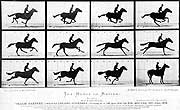 Pioneering
Britisher Eadweard Muybridge (1830-1904), an early photographer and inventor,
was famous for his photographic loco-motion studies (of animals and humans)
at the end of the 19th century (such as 1882's published "The Horse in Motion").
In the 1870s, Muybridge experimented with instantaneously recording the movements of a galloping horse, first at a Sacramento (California) race track. In June, 1878, he successfully conducted a 'chronophotography' experiment
in Palo Alto (California) for his wealthy San Francisco benefactor, Leland Stanford, using a multiple series of cameras
to record a horse's gallops - this conclusively proved that all four of the horse's feet were off the ground at the same time. Pioneering
Britisher Eadweard Muybridge (1830-1904), an early photographer and inventor,
was famous for his photographic loco-motion studies (of animals and humans)
at the end of the 19th century (such as 1882's published "The Horse in Motion").
In the 1870s, Muybridge experimented with instantaneously recording the movements of a galloping horse, first at a Sacramento (California) race track. In June, 1878, he successfully conducted a 'chronophotography' experiment
in Palo Alto (California) for his wealthy San Francisco benefactor, Leland Stanford, using a multiple series of cameras
to record a horse's gallops - this conclusively proved that all four of the horse's feet were off the ground at the same time.
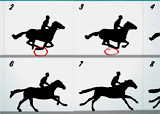
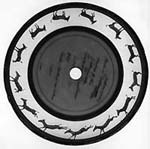 Muybridge's pictures, published widely in the late 1800s, were often
cut into strips and used in a Praxinoscope, a descendant of the
zoetrope device, invented by Charles Emile Reynaud in 1877. The
Praxinoscope was the first 'movie machine' that could project a
series of images onto a screen. Muybridge's stop-action series of photographs
helped lead to his own 1879 invention of the Zoopraxiscope (or
"zoogyroscope", also called the "wheel of life"), a primitive motion-picture projector machine
that also recreated the illusion of movement (or animation) by projecting
images - rapidly displayed in succession - onto a screen from photos printed
on a rotating glass disc. Muybridge's pictures, published widely in the late 1800s, were often
cut into strips and used in a Praxinoscope, a descendant of the
zoetrope device, invented by Charles Emile Reynaud in 1877. The
Praxinoscope was the first 'movie machine' that could project a
series of images onto a screen. Muybridge's stop-action series of photographs
helped lead to his own 1879 invention of the Zoopraxiscope (or
"zoogyroscope", also called the "wheel of life"), a primitive motion-picture projector machine
that also recreated the illusion of movement (or animation) by projecting
images - rapidly displayed in succession - onto a screen from photos printed
on a rotating glass disc.
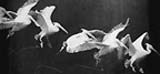 True motion pictures, rather than eye-fooling 'animations', could only
occur after the development of film (flexible and transparent celluloid)
that could record split-second pictures. Some of the first experiments
in this regard were conducted by Parisian innovator and physiologist Etienne-Jules
Marey in the 1880s. He was also studying, experimenting, and recording
bodies (most often of flying animals, such as pelicans in flight) in motion using photographic means (and French astronomer Pierre-Jules-Cesar Janssen's "revolving photographic plate" idea). True motion pictures, rather than eye-fooling 'animations', could only
occur after the development of film (flexible and transparent celluloid)
that could record split-second pictures. Some of the first experiments
in this regard were conducted by Parisian innovator and physiologist Etienne-Jules
Marey in the 1880s. He was also studying, experimenting, and recording
bodies (most often of flying animals, such as pelicans in flight) in motion using photographic means (and French astronomer Pierre-Jules-Cesar Janssen's "revolving photographic plate" idea).
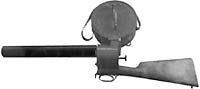 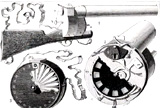 In 1882, Marey, often
claimed to be the 'inventor of cinema,' constructed a camera (or "photographic
gun") that could take multiple (12) photographs per second of moving
animals or humans - called chronophotography or serial photography, similar to Muybridge's work on taking multiple exposed images of running horses. [The term shooting
a film was possibly derived from Marey's invention.] He was able to
record multiple images of a subject's movement on the same camera plate,
rather than the individual images Muybridge had produced. In 1882, Marey, often
claimed to be the 'inventor of cinema,' constructed a camera (or "photographic
gun") that could take multiple (12) photographs per second of moving
animals or humans - called chronophotography or serial photography, similar to Muybridge's work on taking multiple exposed images of running horses. [The term shooting
a film was possibly derived from Marey's invention.] He was able to
record multiple images of a subject's movement on the same camera plate,
rather than the individual images Muybridge had produced.
Marey's chronophotographs (multiple exposures on single glass plates
and on strips of sensitized paper - celluloid film - that passed
automatically through a camera of his own design) were revolutionary.
He was soon able to achieve a frame rate of 30 images. Further experimentation
was conducted by French-born Louis Aime Augustin Le Prince in 1888. Le
Prince used long rolls of paper covered with photographic emulsion for
a camera that he devised and patented. Two short fragments survive of
his early motion picture film (one of which was titled Traffic Crossing
Leeds Bridge).
The work of Muybridge, Marey and Le Prince laid
the groundwork for the development of motion picture cameras,
projectors and transparent celluloid film - hence the development
of cinema. American inventor George Eastman, who had first manufactured
photographic dry plates in 1878, provided a more stable type
of celluloid film with his concurrent developments in 1888 of
sensitized paper roll photographic film (instead of metal or
glass plates) and a convenient "Kodak" small box camera
(a still camera) that used the roll film. He improved upon the
paper roll film with another invention in 1889 - perforated celluloid (synthetic
plastic material coated with gelatin)
roll-film with photographic, light-sensitive emulsion, and sprocket
holes along the sides.
The Birth of US Cinema:
Thomas Edison and William K.L. Dickson
 In
the late 1880s, famed American inventor Thomas Alva Edison (1847-1931)
(and his young British assistant William Kennedy Laurie Dickson
(1860-1935)) in his industrial-research laboratories in West Orange,
New Jersey, borrowed from the earlier work of Muybridge, Marey,
Le Prince and Eastman. Their goal was to construct a device for
recording movement on film, and another device for viewing the
film. Dickson must be credited with most of the creative and innovative
developments - Edison only provided the research program and his
laboratories for the revolutionary work. In
the late 1880s, famed American inventor Thomas Alva Edison (1847-1931)
(and his young British assistant William Kennedy Laurie Dickson
(1860-1935)) in his industrial-research laboratories in West Orange,
New Jersey, borrowed from the earlier work of Muybridge, Marey,
Le Prince and Eastman. Their goal was to construct a device for
recording movement on film, and another device for viewing the
film. Dickson must be credited with most of the creative and innovative
developments - Edison only provided the research program and his
laboratories for the revolutionary work.
Although Edison is often credited with the
development of early motion picture cameras and projectors, it was Dickson,
in November 1890, who devised a crude, motor-powered camera that could
photograph motion pictures - called a Kinetograph. It was the
world's first motion-picture film camera - heavy and static, and requiring
lots of light. This was one of the major reasons for the emergence
of motion pictures in the 1890s. Edison Studios was formally known
as the Edison
Manufacturing Company (1894-1911), with innovations due largely
to the work of Edison's assistant Dickson in the mid-1890s. The motor-driven
camera was designed to capture movement with a synchronized shutter
and sprocket system (Dickson's unique invention) that could move the
film through the camera by an electric motor. The Kinetograph used
film which was 35mm wide and had sprocket holes to advance the film.
The sprocket system would momentarily pause the film roll before the
camera's shutter to create a photographic frame (a still or
photographic image).
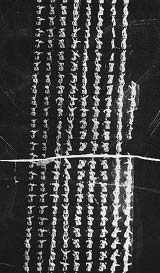
In 1889 or 1890, Dickson filmed his first experimental
Kinetoscope trial or test film, Monkeyshines No. 1 (1889/1890),
the only surviving film from the cylinder kinetoscope, and apparently
the first motion
picture ever produced on photographic film in the United States. It
featured the movement of laboratory assistant Sacco Albanese, filmed
with a system using tiny images that rotated around the cylinder.
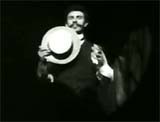 Dickson
Greeting (1891), apparently the second film made in the US, was
composed of test footage of William K.L. Dickson himself, bowing, smiling
and ceremoniously taking off his hat. It was a three-second clip. It
was used for one of the first public demonstrations
of motion pictures in the US using the Kinetoscope, presented to the
Federation of Women's Clubs. Dickson
Greeting (1891), apparently the second film made in the US, was
composed of test footage of William K.L. Dickson himself, bowing, smiling
and ceremoniously taking off his hat. It was a three-second clip. It
was used for one of the first public demonstrations
of motion pictures in the US using the Kinetoscope, presented to the
Federation of Women's Clubs.
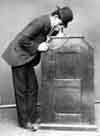 In
1891, Dickson also designed an early version of a movie-picture projector
(an optical lantern viewing machine) based on the Zoetrope - called
the
Kinetoscope. It was a peep-show device to allow one person at
a time to watch a 'movie.'
Dickson and Edison also built a vertical-feed motion picture camera in
the summer of 1892. In
1891, Dickson also designed an early version of a movie-picture projector
(an optical lantern viewing machine) based on the Zoetrope - called
the
Kinetoscope. It was a peep-show device to allow one person at
a time to watch a 'movie.'
Dickson and Edison also built a vertical-feed motion picture camera in
the summer of 1892.
The formal introduction of the Kinetograph in October
of 1892 set the standard for theatrical motion picture cameras still
used today. It used a film strip (composed of celluloid coated in
light-sensitive emulsion) that was 1 1/2 inches wide. This established
the basis for today's standard 35 mm commercial film gauge, occurring
in 1897. The 35 mm width with 4 perforations per frame became accepted
as the international standard gauge in 1909. However, moveable hand-cranked
cameras soon became more popular, because the original motor-driven
cameras were heavy and bulky.
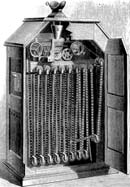
On Saturday, April 14, 1894, a refined version of Edison's
Kinetoscope began commercial operation for entertainment purposes.
The floor-standing, box-like viewing device was basically a bulky,
coin-operated, movie "peep
show" cabinet for a single customer (in which the
images on a continuous film loop-belt were viewed in motion as they
were rotated in front of a shutter and an electric lamp-light). It
held 40-50 foot rolls of 'film' - about 16 seconds of viewing time
(of one single, uninterrupted shot). The Kinetoscope, the forerunner
of the motion picture film projector (without sound), was finally patented
on August 31, 1897 (Edison applied for the patent in 1891, granted
in 1893). The viewing device quickly became popular in carnivals, Kinetoscope
parlors, amusement arcades, and sideshows for a number of years.
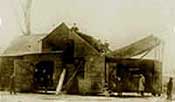 The
world's first film production studio - or "America's first
movie studio," the Black Maria,
or the Kinetographic Theater (and dubbed "The Doghouse" by
Edison himself), was built on the grounds of Edison's laboratories
at West Orange, New Jersey. Construction
began in December 1892, and it was completed by February 1, 1893,
at a cost of $637.67 (about $16,000 in 2015). It was constructed for
the purpose of making film strips for the Kinetoscope. The interior
walls of the studio were covered with black tar-paper (to make
the performers stand out against the stark black backgrounds).
It had a retractable or hinged, flip-up sun-roof to allow sunlight
in. It was built with a rotating base or turntable (on circular
railroad tracks) to orient itself throughout the day to follow
the natural sunlight. The
world's first film production studio - or "America's first
movie studio," the Black Maria,
or the Kinetographic Theater (and dubbed "The Doghouse" by
Edison himself), was built on the grounds of Edison's laboratories
at West Orange, New Jersey. Construction
began in December 1892, and it was completed by February 1, 1893,
at a cost of $637.67 (about $16,000 in 2015). It was constructed for
the purpose of making film strips for the Kinetoscope. The interior
walls of the studio were covered with black tar-paper (to make
the performers stand out against the stark black backgrounds).
It had a retractable or hinged, flip-up sun-roof to allow sunlight
in. It was built with a rotating base or turntable (on circular
railroad tracks) to orient itself throughout the day to follow
the natural sunlight.
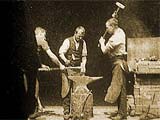 Thomas
Edison displayed 'his' Kinetoscope projector at the World's Columbian
Exhibition in Chicago and received patents for his movie camera, the Kinetograph,
and his electrically-driven peepshow device - the Kinetoscope.
In early May, 1893, Edison also held the world's first public exhibition
or demonstration of films at the Brooklyn Institute of Arts and Sciences.
The exhibited 34-second film, Blacksmith
Scene (1893), was viewed on Dickson's Kinetoscope viewer, and
was shot using a Kinetograph at the Black Maria. It showed
three people pretending to be blacksmiths. Thomas
Edison displayed 'his' Kinetoscope projector at the World's Columbian
Exhibition in Chicago and received patents for his movie camera, the Kinetograph,
and his electrically-driven peepshow device - the Kinetoscope.
In early May, 1893, Edison also held the world's first public exhibition
or demonstration of films at the Brooklyn Institute of Arts and Sciences.
The exhibited 34-second film, Blacksmith
Scene (1893), was viewed on Dickson's Kinetoscope viewer, and
was shot using a Kinetograph at the Black Maria. It showed
three people pretending to be blacksmiths.
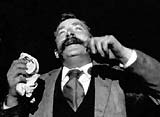 The
first motion pictures made in the Black Maria were deposited for copyright
by Dickson at the Library of Congress in August, 1893. On January 7,
1894, The Edison Kinetoscopic Record of a Sneeze (aka Fred
Ott's Sneeze (1894)) became the first film officially
registered for copyright. It was one of the first series of short
films made by Dickson for the Kinetoscope viewer in Edison's Black
Maria studio with fellow assistant Fred Ott.
The short five-second film was made for publicity purposes, as a series
of still photographs to accompany an article in Harper's Weekly.
It was the earliest surviving, copyrighted motion picture
(or "flicker")
- composed of an optical record (and medium close-up) of
Fred Ott, an Edison employee, sneezing comically for the camera. It
was noted as the first medium-closeup. The
first motion pictures made in the Black Maria were deposited for copyright
by Dickson at the Library of Congress in August, 1893. On January 7,
1894, The Edison Kinetoscopic Record of a Sneeze (aka Fred
Ott's Sneeze (1894)) became the first film officially
registered for copyright. It was one of the first series of short
films made by Dickson for the Kinetoscope viewer in Edison's Black
Maria studio with fellow assistant Fred Ott.
The short five-second film was made for publicity purposes, as a series
of still photographs to accompany an article in Harper's Weekly.
It was the earliest surviving, copyrighted motion picture
(or "flicker")
- composed of an optical record (and medium close-up) of
Fred Ott, an Edison employee, sneezing comically for the camera. It
was noted as the first medium-closeup.
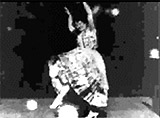 A short film (about 21 seconds long) titled Carmencita
(1894) was directed and produced by Edison's employee William
K.L. Dickson. She was filmed March 10-16, 1894 in Edison's Black
Maria studio in West Orange, NJ. Spanish dancer Carmencita was the
first woman to appear in front of an Edison motion picture camera,
and quite possibly the first female to appear in a US motion picture.
In some cases, the projection of the scandalous film on a Kinetoscope
was forbidden, because it revealed Carmencita's legs and undergarments
as she twirled and danced. This was one of the earliest cases of
censorship in the moving picture industry. A short film (about 21 seconds long) titled Carmencita
(1894) was directed and produced by Edison's employee William
K.L. Dickson. She was filmed March 10-16, 1894 in Edison's Black
Maria studio in West Orange, NJ. Spanish dancer Carmencita was the
first woman to appear in front of an Edison motion picture camera,
and quite possibly the first female to appear in a US motion picture.
In some cases, the projection of the scandalous film on a Kinetoscope
was forbidden, because it revealed Carmencita's legs and undergarments
as she twirled and danced. This was one of the earliest cases of
censorship in the moving picture industry.
Most of the first films shot at the Black Maria included
segments of magic shows, excerpts from stage plays, slapstick comedy,
vaudeville performances (with dancers and strongmen), acrobatics, acts
from Buffalo Bill's Wild West Show and other animal acts, various boxing
matches and cockfights, and scantily-clad women. Most of the earliest
moving images, however, were non-fictional, unedited, crude documentary, "home
movie" views of ordinary
slices of life - street scenes, the activities of police or firemen,
or shots of a passing train. [Footnote: the 'Black Maria' studio appeared
in Universal's comedy Abbott and Costello Meet the Keystone Cops
(1955).]
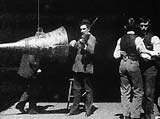 In the early 1890s, Edison and Dickson also devised a prototype sound-film system called the Kinetophonograph or Kinetophone -
a precursor of the 1891 Kinetoscope with a cylinder-playing phonograph
(and connected earphone tubes) to provide the unsynchronized sound.
The projector was connected to the phonograph with a pulley system,
but it didn't work very well and was difficult to synchronize. It was
formally introduced in 1895, but soon proved to be unsuccessful since
competitive, better synchronized devices were also beginning to appear
at the time. The first known (and only surviving) film with live-recorded
sound made to test the Kinetophone was the 17-second Dickson Experimental
Sound Film (1894-1895). In the early 1890s, Edison and Dickson also devised a prototype sound-film system called the Kinetophonograph or Kinetophone -
a precursor of the 1891 Kinetoscope with a cylinder-playing phonograph
(and connected earphone tubes) to provide the unsynchronized sound.
The projector was connected to the phonograph with a pulley system,
but it didn't work very well and was difficult to synchronize. It was
formally introduced in 1895, but soon proved to be unsuccessful since
competitive, better synchronized devices were also beginning to appear
at the time. The first known (and only surviving) film with live-recorded
sound made to test the Kinetophone was the 17-second Dickson Experimental
Sound Film (1894-1895).
Kinetoscope Parlors and Films Flourish:
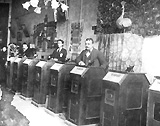  On April
14, 1894, the Holland Brothers opened the first Kinetoscope Parlor
at 1155 Broadway in New York City and for the first time,
they commercially exhibited movies, as we know them today, in their
amusement arcade. Each
film cost 5 cents to view. Patrons paid 25 cents as the admission charge
to view films in five kinetoscope machines placed in two rows. The
first commercial presentation of a motion picture took place here.
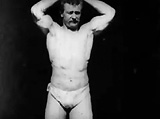
The mostly male audience was entertained by a single loop reel depicting
clothed female dancers, sparring boxers and body builders (such as Sandow
the Strong Man (1894)), animal acts and everyday scenes. Early
spectators in Kinetoscope parlors were amazed by even the most mundane
moving images in very short films (between 30 and 60 seconds) - an approaching
train or a parade, women dancing, dogs terrorizing rats, and twisting
contortionists. On April
14, 1894, the Holland Brothers opened the first Kinetoscope Parlor
at 1155 Broadway in New York City and for the first time,
they commercially exhibited movies, as we know them today, in their
amusement arcade. Each
film cost 5 cents to view. Patrons paid 25 cents as the admission charge
to view films in five kinetoscope machines placed in two rows. The
first commercial presentation of a motion picture took place here.
The mostly male audience was entertained by a single loop reel depicting
clothed female dancers, sparring boxers and body builders (such as Sandow
the Strong Man (1894)), animal acts and everyday scenes. Early
spectators in Kinetoscope parlors were amazed by even the most mundane
moving images in very short films (between 30 and 60 seconds) - an approaching
train or a parade, women dancing, dogs terrorizing rats, and twisting
contortionists.
Soon, peep show Kinetoscope parlors quickly opened
across the country, set up in penny arcades, hotel lobbies, and
phonograph parlors in major cities across the US. One
of the companies formed to market Edison's Kinetoscopes and the films
was called the Kinetoscope Exhibition Company. It was owned by
Otway Latham, Grey Latham, Samuel Tilden, and Enoch Rector. In the summer
of 1894 in downtown New York City (at 83 Nassau St.), it set up a series
of large-capacity Kinetoscopes (able to handle up to 150 feet of film),
each one showing one, one–minute round of the
six round Michael Leonard-Jack Cushing Prize Fight (1894) film
(produced and filmed at Edison's Black Maria studio). Each viewing
cost 10 cents, or 60 cents to see the entire fight. The popular boxing
film was the first boxing film produced for commercial exhibition.
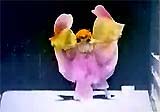 In June of 1894, pioneering inventor
Charles Francis Jenkins became the first person to project a filmed
motion picture onto a screen for an audience, in Richmond, Indiana,
using his projector termed the Phantoscope. The motion picture
was of a vaudeville dancer doing a butterfly dance - the first motion
picture with color (tinted frame by frame, by hand). Some of the earliest color hand-tinted films ever publically-released were Annabelle
Butterfly Dance (1894), Annabelle Sun Dance (1894), and
Annabelle Serpentine Dance (1895) featuring the dancing of vaudeville-music
hall performer Annabelle Whitford (known as Peerless Annabelle) Moore,
whose routines were filmed at Edison's studio in New Jersey. Male audiences
were enthralled watching these early depictions of a clothed female
dancer (sometimes color-tinted) on a Kinetoscope - an early peep-show
device for projecting short films. In June of 1894, pioneering inventor
Charles Francis Jenkins became the first person to project a filmed
motion picture onto a screen for an audience, in Richmond, Indiana,
using his projector termed the Phantoscope. The motion picture
was of a vaudeville dancer doing a butterfly dance - the first motion
picture with color (tinted frame by frame, by hand). Some of the earliest color hand-tinted films ever publically-released were Annabelle
Butterfly Dance (1894), Annabelle Sun Dance (1894), and
Annabelle Serpentine Dance (1895) featuring the dancing of vaudeville-music
hall performer Annabelle Whitford (known as Peerless Annabelle) Moore,
whose routines were filmed at Edison's studio in New Jersey. Male audiences
were enthralled watching these early depictions of a clothed female
dancer (sometimes color-tinted) on a Kinetoscope - an early peep-show
device for projecting short films.
Young
Griffo v. Battling Charles Barnett (1895) was the first 'movie'
or motion picture in the world to be screened for a paying audience on
May 20, 1895, at a storefront at 156 Broadway in NYC. [This was more
than seven months before the Lumière brothers showed their film
in Paris (see below).] The 8-minute
B&W
silent film (shown on one continuous
reel of film without interruption, using the "Latham Loop" to
prevent tearing) was made by Woodville Latham and his sons Otway and
Grey. The staged boxing match had been filmed with an Eidoloscope Camera
on the roof of Madison Square Garden on May 4, 1895 between Australian
boxer Albert Griffiths (Young Griffo) and Charles Barnett. Shortly
thereafter, nearly 500 people became cinema's first major audience
during the showings of films with titles such as Barber Shop, Blacksmiths, Cock
Fight, Wrestling,
and Trapeze. Edison's
film studio was used to supply films for this sensational new form
of entertainment. More Kinetoscope parlors soon opened in other
cities (San Francisco, Atlantic City, and Chicago).
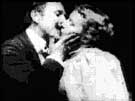 The Kiss (1896) (aka The May Irwin Kiss) was
the first film ever made of a couple kissing in cinematic history.
May Irwin and John Rice re-enacted a lingering kiss for Thomas Edison's
film camera in this 20-second long short, from their 1895 Broadway
stage play-musical The Widow Jones. It became the most popular
film produced that year by Edison's film company (it was filmed at
Edison's Black Maria studio, in West Orange, NJ), but was also notorious
as the first film to be criticized as scandalous and bringing demands
for censorship. The Kiss (1896) (aka The May Irwin Kiss) was
the first film ever made of a couple kissing in cinematic history.
May Irwin and John Rice re-enacted a lingering kiss for Thomas Edison's
film camera in this 20-second long short, from their 1895 Broadway
stage play-musical The Widow Jones. It became the most popular
film produced that year by Edison's film company (it was filmed at
Edison's Black Maria studio, in West Orange, NJ), but was also notorious
as the first film to be criticized as scandalous and bringing demands
for censorship.
The American Mutoscope Company: Dickson's Split From
Edison
Disgruntled and a disenchanted inventor, William K.L.
Dickson left Edison to form his own company in 1895, called the American
Mutoscope Company (see more further below), the first and
the oldest movie company in America. A nickelodeon film producer who
had been working with Thomas Edison for a number of years, Dickson
left following a disagreement. Three others joined Dickson, inventors
Herman Casler and Henry Marvin, and an investor named Elias Koopman.
The company was set up at 841 Broadway, in New York - its sole focus
was to produce and distribute moving pictures. The business was moved
to Canastota, NY. Superior alternatives to the Kinetoscope were
the company's invention of the Mutoscope -
a hand-cranked viewing device utilizing bromide prints or illustrated
cards in a 'flick-book' principle, and the Biograph projector, released
in the summer of 1896 - a projector using large-format, wide-gauge 68
mm film (different from Edison's 35mm). The Biograph soon
became the chief US competitor to Edison's Kinetoscope and Vitascope.
[Note: The American Mutoscope Company eventually
became the Biograph
Company.]
[By the 1897 patent
date of the Kinetoscope, both the camera (kinetograph) and the method
of viewing films (kinetoscope) were on the decline with the advent
of more modern screen projectors for larger audiences.]
 Film History of the Pre-1920s
Part 1, Part 2, Part 3, Part 4, Part 5


|