
|
Bombs, Disasters and Film Flops: The Most Notable Examples 1950-1966 |

|
(chronologically, by film title) Intro | Summary Chart | Silents-1949 | 1950 -1966 | 1967-1969 | 1970-1974 | 1975-1977 | 1978-1979 1980 | 1981 | 1982 | 1983-1984 | 1985-1986 | 1987-1989 1990-1991 | 1992-1994 | 1995 - 1 | 1995 - 2 | 1996-1997 | 1998 | 1999 | 2000 | 2001 - 1 | 2001 - 2 2002 - 1 | 2002 - 2 | 2002 - 3 | 2003 | 2004 | 2005 | 2006 | 2007-2011 | 2012-2014 | 2015-2017 | 2018-2019 | 2020-2021 |
|
| Film Title, Director, Studio, Budget Information, Description | |
|
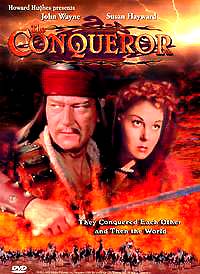
The Conqueror (1956) This much-troubled, lavish epic production from RKO, better titled "The Genghis Khan Story," was heralded with taglines: "Spectacular as its barbaric passions and savage conquests!" and "They conquered each other and then the world" - little knowing that the phrases would become true in unexpected ways. Musical dancer/crooner Dick Powell directed (it was his second film as director after Split Second (1953)). It was executive-produced by the notoriously-eccentric studio head Howard Hughes (his next-to-last film along with Jet Pilot (1957)), already famous for the film fiasco related to The Outlaw (1943), who was running the studio into the ground with a series of self-indulgent and expensive flops. Filmed on location near St. George, Utah (in Snow Canyon) close to nuclear weapons testing grounds in Nevada (at Yucca Flat), the radioactive side-effects eventually were hypothetically linked to the deaths of the major stars and the film's director. (Additional exposure to the radioactive earth occurred when 60 tons of it was shipped back to Hollywood by Hughes for additional reshoots). Filming was also plagued by a threatening flash flood, and searing 120 degree heat which affected the actors with heavy makeup and costuming. Reportedly guilty about the demise of so many related to the film, the increasingly-reclusive Hughes bought up all copies of this film and Jet Pilot (for $12 million) and kept them from public view for 17 years, until 1974, when Paramount secured the rights and it was broadcast on TV. In this troubled early Cinemascope production (with four cinematographers), John Wayne was horribly miscast as Mongolian 12th century warlord conqueror Genghis Khan (or Temujin) (Marlon Brando was originally considered for the role), with Agnes Moorehead as his mother Hunlun, and Susan Hayward as pretty red-haired Tartar love interest Princess Bortai (who Wayne coveted, as he said: "I feel this Tartar woman...is for me...and my blood says...take her" and later, "She is a woman -- much woman!"). This "Oriental western," made with a cast of thousands, actually looked like there were only 40-50 in wide-shots, and included buxom harem dancers and an Oriental-sounding score (by Victor Young). The preposterous script, coupled with Wayne's wooden (often with cowboyish drawling) and monotonous delivery of the inane dialogue (Sample: "You're beautiful in your wrath. I shall keep you, Bortai!") and his horrible makeup (slanty eyes and a "Charlie Chan" mustache) made for some campy moments. Bortai's forced rape scene by Temujim was modified due to the demands of the censoring Breen Office - in his brutal grasp, Temujim was forced to claim: "Know this, woman, I take you for wife!" Critics quickly denounced the film as unintentionally hilarious, although Hughes claimed it was one of his masterpieces and heralded the film with an expensive marketing campaign. It was one of the higher-grossing films of its year, but it couldn't recoup all of his unprecedented costs. |
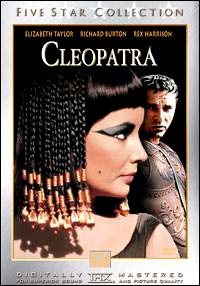 |
Cleopatra (1963) The much-heralded Joseph L. Mankiewicz film, shot on location in Rome, brought together the explosive pairing of Elizabeth Taylor as the Queen of Egypt (from 51 B.C. to 30 B.C.) and future husband Richard Burton as Marc Antony, who brought more headlines with their blossoming romance than the budget problems. It proved to be a tremendous financial disaster for 20th Century Fox, headed by Darryl Zanuck, and the entire studio system. Violet-eyed Taylor (after her Oscar nomination as steamy Maggie in Cat on a Hot Tin Roof (1958)), secured a contract with 20th Century Fox in October 1959 to star in this film - and she simultaneously became the highest-paid performer in the history of Hollywood at $1 million for a single picture, the first Hollywood star to do so. Her costume wardrobe (of about 5 dozen costumes) was budgeted at almost $200,000, and with numerous cost over-runs, two directors (the first director was Rouben Mamoulian, who resigned in early 1961), extravagant sets and thousands of costumes for the cast, the film was the most expensive up to that time at a record $44 million (in adjusted dollars, about $300 million). It was also the longest, commercially-made American film released in the US - at 4 hours and 3 minutes. Another expensive consideration was Taylor's contractual insistence that the film be shot using the 70 mm Todd AO-process developed by her husband. 20th Century Fox's monumentally-unwieldy epic was plagued by difficulties during the long shooting schedule, including indulgent star Elizabeth Taylor's long illness with meningitis and then another near-death illness (pneumonia) that forced an emergency tracheotomy (and a visible neck scar), the rebuilding of expensive sets in Rome's Cinecitta Studios when the production was moved there from the original shooting location of Pinewood Studios in London, a highly-publicized adulterous affair between Taylor (who had earlier 'stolen' Eddie Fisher from Debbie Reynolds) and Richard Burton, an extensive script re-write, a cast and crew of thousands, a defection of two highly-distinguished stars from the film (Peter Finch as Julius Caesar and Stephen Boyd as Marc Antony), and escalating runaway costs (from an original budget of $2 - $6 million to well over $40 million). When the filming was suspended in mid-1961 after a year in London, $6 million had been spent with only 12 minutes of usable footage. After the lavish film was completed with some very impressive and spectacular set-pieces, the six-hour epic had to be seriously cut (almost in half), resulting in a choppy, disjointed and fragmented film of over 4-hours. Since it was a lengthy film, theatre owners rationalized the $5.50 per ticket charge - three times more than normal for 1963. However, 20th Century Fox was forced to sell off its backlot to developers in the area of LA's Century City when the film bombed. Producer Darryl Zanuck ordered an additional 21 minutes cut from the film, and it received a questionable Academy Awards Best Picture nomination. The studio claimed that the film eventually went on to become the year's highest-grossing film, despite its heavy financial losses and astounding price-tag (due in part to large and expensive lawsuits in the film's wake). Fox was saved from complete financial disaster only by the release of the fact-based war epic The Longest Day (1963) - an all-star re-creation of the events surrounding D-Day, and the blow was also softened by the unexpected success of The Sound of Music (1965). A TV documentary was made to chronicle the epic film and its lasting impact: Cleopatra: The Film That Changed Hollywood (2001). |
|
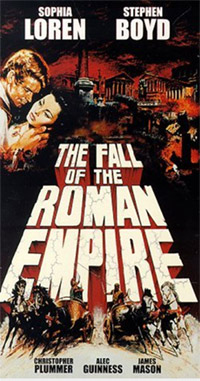
The Fall of the Roman Empire (1964) This dramatic, 3-hour historical epic of the 'sword-and-sandal' variety by director Anthony Mann was made at an exorbitant cost. It was produced at a time when cinema was mightily competing with television, so the sets and scope of these kinds of films had to be even more spectacular and opulent and filled with pageantry. For its plodding length, it only covered the 'beginnings' of the Fall of the Roman Empire from 180-192 AD. The gorgeous but boring film with a high-profile cast, made in Ultra Panavision (70 mm), and filmed on location in Spain, boasted an original orchestral score by Dimitri Tiomkin. Much of the cost was due to its reconstruction of massive sets, such as the ancient Roman Forum (heralded as the largest outdoor film set at 55 acres). Its impressive 'Battle of the Four Armies' sequence alone required thousands of extras to comprise the 8,000 soldiers (including 1,200 cavalry). But as with many of these historical cinematic efforts, the facts were often excessively distorted in the telling of Rome's history. Due to its financial failure at the box-office, producer Samuel Bronston was forced to file for bankruptcy. He had made many previous epic films, including King of Kings (1961), El Cid (1961), and the troubled 55 Days at Peking (1963). It was possible that film audiences had grown tired of such grand epics, following the massive failure of Cleopatra (1963) a year earlier. There were a number of similarities between this epic and Ridley Scott's gladiatorial film Gladiator (2000). Alec Guinness starred as the wise diplomatic Roman Emperor Marcus Aurelius, Stephen Boyd as his altruistic adopted son Livius, Christopher Plummer as the rightful successor Commodus, and Sophia Loren (who was paid the highest salary of $1 million) as Marcus' daughter Lucilla, Livius' beloved. |
|
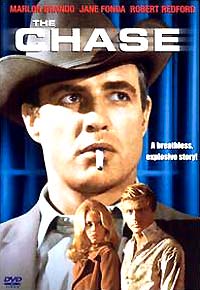
The Chase (1966) Just before Arthur Penn scored a huge success with Bonnie and Clyde (1967), he directed this strangely-titled, pot-boiling action thriller with Marlon Brando in a starring role as a Southwestern Texas town's conflicted and loner Sheriff Calder - set against his entire local community on a hot Saturday afternoon/evening. The uncompromising, explosive and trashy film, with liberal doses of infidelity and sex, violence, bigotry and racism, hatred and corruption, was scripted by previously-blacklisted Lillian Hellman from the play by Horton Foote. The "breathless, explosive story" reflected the turbulent time of the mid-60s, known for political assassinations, racial problems and widespread prejudice, and the growing war in Vietnam. The disjointed, violent Peyton Place-like film with multiple storylines and characters told about the ramifications of the prison escape of framed (and innocent) inmate Charlie 'Bubber' Reeves (Robert Redford in a small star-making breakout role) for car-theft, bound for his hometown of Tarl to see his wife Anna Reeves (Jane Fonda) and take shelter. She had taken up with the married Jake Rogers (James Fox), the no-good son of powerful local oil and cattle baron Val Rogers (E. G. Marshall) - the town's "boss". Everyone had reason to fearfully anticipate Bubber's return: the unfaithful Jake and Anna for having an affair, meek bank VP Edwin Stewart (Robert Duvall) for an old childhood-related incident and for his amoral and slutty wife Emily's (Janice Rule) sexpot behavior, and Bubber's own guilt-ridden parents (Miriam Hopkins and Malcolm Atterbury) who wanted to prevent Sheriff Calder from killing their fugitive son on the run. Drunken vigilante mob rule threatened and brutally beat the masochistic, unrespected Sheriff (who owed his "bought" position and support to Val) when he stood up for himself, while his sole defender was his loyal and long-suffering wife Ruby (Angie Dickinson). [The graphic and bloody beating from redneck Damon Fuller (Richard Bradford) recalled Oscar-winning Brando's similar throttling at the conclusion of On the Waterfront (1954), but even more intense due to its being filmed in color.] Bubber was eventually apprehended and brought to jail but in a moment that echoed the murder of Lee Harvey Oswald in 1963, was tragically shot while brought into custody and handcuffed, causing Calder to beat the killer Archie (Steve Ihnat) senseless and then leave the town the next day with his supportive wife to an uncertain destination (reminiscent of High Noon (1952)). Penn was disappointed with the overwrought, in-your-face film, although it was a masterpiece of contrived volatility. He denounced it, blaming producer Sam Spiegel for interfering with the film's making and limiting his participation in the final edit. The film ended up being both a critical and commercial failure, and bombed at the box-office due to negative reviews. Revisionistic critics hailed the film, however, as a foreshadowing of recurring themes of sex and violence (and the depiction of the disintegration of American society) that would be blossoming in numerous films in the coming years and decades. |