|
Films of All-Time 1962-1967 |

|
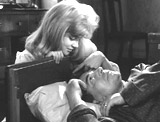
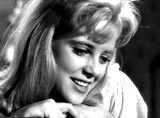
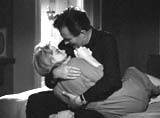
Lolita (1962, UK)
Stanley Kubrick's sixth film - a brilliant, sly adaptation of Vladimir Nabokov's celebrated yet controversially-infamous 1955 novel of a middle-aged man's unusual, doomed sexual passion/obsession for a precocious, seductive "nymphet" girl, was cause for some concern. [The scandalous book was banned in Paris in 1956-1958, and not published in its full form in the US or UK until 1958.] The question: "How did they ever make a movie of Lolita?" was actually asked on the film's posters. The X-rated UK film's Hollywood premiere disallowed young star Sue Lyon (14-15 years old at the time of filming) from attending. Although Nabokov was appointed to write the screenplay for his own lengthy novel, Kubrick rewrote (with co-producer James B. Harris) Nabokov's unacceptable versions of the script in a more sanitized fashion. The age of Lolita in the novel was raised from 12 years old to that of a typical high-schooler - probably 14 or 15, to avoid some predicted controversy. The threat of censorship and denial of a Seal of Approval from the film industry's production code and the Roman Catholic Legion of Decency overshadowed the film's production. The black humor and dramatic story of juvenile temptation and perverse, late-flowering lust was centered on a pubescent nymphet and a mature literature professor in an aura of incest. Rather than a film of overt sexuality and prurient subject matter, its content was deliberately mostly suggestive, with numerous double entendres, whisperings, meaningful facial expressions, and metaphoric sexual situations, with carefully-placed fades to black. Its most troublesome character who assumed various disguises, was actually Clare Quilty (Peter Sellers) - an implied pedophile and child pornographer. The film opened with an erotic pedicure scene under the credits of obsessed, middle-aged boarder and literature professor Humbert Humbert (James Mason) cradling the title character's foot and then lovingly and devotedly painting her toenails with bright enamel - hinting at pedophilia. Sue Lyon starred as the title character Dolores Haze - a tempting, precocious, iconic, underaged nymphet nicknamed Lolita. The first image of skimpy, sultry and nubile bikini-clad 'Lolita' was sunbathing in her back yard in a two-piece bathing suit - sporting a broad-brimmed, feathered straw hat and heart-shaped plastic sunglasses - accompanied by a "Yi Yi" bubble-gum theme song as Humbert eyed her and was led through the house by Lolita's blowsy mother Charlotte (Shelley Winters), as she noted: ("My flowers win prizes around here! They're the talk of the neighborhood. Voila!...My yellow roses. My - daughter....I can offer you a comfortable home, a sunny garden, a congenial atmosphere, my cherry pies"); Humbert immediately accepted her offer to rent a room, and explained his decision-making: ("I think it was your cherry pies!"). Later, Humbert was slyly leering at Lolita over the top edge of the book he was pretending to read, as she practiced twirling a hula-hoop around her thrusting, pubescent hips while counting the rotations. Lolita continually teased (unintentional and intentional) of Humbert, and gave words of farewell to Humbert and her half-winking at him as she went away to summer camp:
Soon after, to be near Charlotte's seductive child so that he could proceed with his nymphetomania, Humbert realized that he must marry Charlotte. Things took a turn in Humbert's favor when Charlotte accidentally died in a vehicular incident outside the home. Charlotte's untimely death meant widower Humbert became Lolita's legal guardian and stepfather. Humbert drove the Haze station wagon to pick her up from summer camp; the aptly-named camp sign welcomed him: "CAMP CLIMAX FOR GIRLS - Drive Carefully"; he was reluctant to tell Lolita the truth about her mother's death - but he confessed his love for the not-so-naive Lolita and she responded: "You haven't even kissed me yet, have you?" The film was noted for the scene of their overnight stay at a hotel and Lolita's early morning coquettish suggestion to play a game that she learned at camp, while seductively twirling the hair on his head with her finger ("I-I learned some real good games in camp. One in particular-ly was fun... Well, I played it with Charlie...He's that guy that you met in the office....You sure you can't guess what game I'm talking about?...You mean you never played that game when you were a kid?...All righty then...") -- followed by a discrete fade to black.
Four years later, Humbert saw Lolita once again after she had married and was six months pregnant - and in debt; he greeted her: ("So this is what Mrs. Richard T. Schiller looks like!"); Lolita was very unlike the sultry, sleek young girl he had remembered a few years earlier; she admitted to having had a continuing affair with another of the film's prominent characters, TV writer Clare Quilty, another pedophile; Humbert made one final plea to rescue her from her shabby, bland existence in a hovel (with her superficial husband) and return to their own world of the past; when she denied his request, he cried and poignantly reached for over $400 in cash, a check for $2,500, and a mortgage document (from her mother's estate) worth about $10,000; Lolita was astonished and concerned:
Afterwards, Humbert rushed for his car, as she called out from the door with the wad of cash in her hand: "Hey, well listen, let's keep in touch, huh? I'll write to you when we get to Alaska." [See also entry for the remake - Lolita (1997).] |
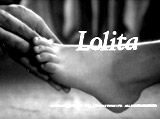 Pedicure: Opening Credits 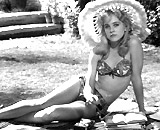 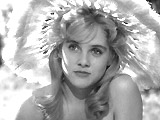 First View of Lolita 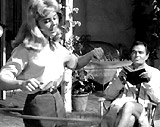 Lolita with Hula-Hoop While Spied Upon 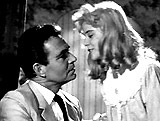 Humbert's Growing Interest in Lolita 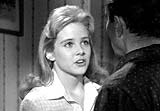 Lolita's Goodbye: "Don't forget me" 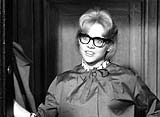 Lolita - Married 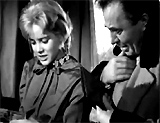 Humbert with Married and Pregnant Lolita - Offering Her Cash |
||||||||||||||||||

|
Mondo Cane (1962, It.) (aka A
Dog's World)
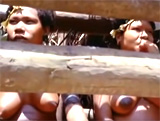
This popular Italian-made globe-trotting, amateurish "shockumentary" or "antidocumentary" was luridly advertised as a travelogue of "truth stranger than fiction" - with xenophobic glimpses of dark-skinned, bare 'savages' engaged in grotesque and bizarre religious rituals, tribal ceremonies, many scenes of animal abuse and cruelty, and lurid scenes of human perversity! It inspired a series of sequel "Mondo" films (or "shockumentaries") and dozens of imitators, including Rolf Olsen's Shocking Asia (1974) and Conan Le Cilaire's Faces of Death, Part 1 (1978) series of films. It was the progenitor of "snuff" films, execution videos, hard-core pornography, and even reality TV. The film was castigated as pornographic, trashy and vulgar for its taboo subject matter, although by today's standards, the offensive scenes would be considered extremely tame. Allegedly real scenes were often intermixed with faked, reconstructed or manipulated footage (with misleading narration):
|
  "Man-Hunting" Native Girls in the Trobriand Islands   Flirtatious Busty Women  Piglet Being Breast-Fed  Pig Slaughtering-Roasting Feast  Eggs Destined to Never Hatch on Bikini Atolls After Nuclear Testing  Disoriented Turtle Without Sense of Direction  Underwater Human Cemeteries that Attracted Sharks  Funeral Make-Up Applied to the Deceased  Car Crushing Machine in Los Angeles - Converting Cars into Cubes  Human Paint Brushes  Hawaiian Leis Presented to Disembarking Cruise Passengers  Bull-Fighting in an Arena in Portugal |
||||||||||||||||||
|
Blood Feast (1963)
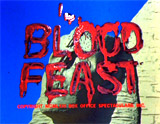
Sexploitation gore-fest director Herschell Gordon Lewis' career was launched with this low-budget cult film (starring June 1963 Playboy Playmate Connie Mason as Suzette Fremont). The 67-minute work was filmed in only 9 days (with a budget of about $25,000), and grossed $4 million. Lewis partnered with producer David Friedman, to branch off from their "nudie-cutie" sex films into the horror genre, in part to avoid conflict with censorship boards. The crude, ineptly-acted, and salacious Z-grade horror film is usually considered to be the first distinctive horror 'splatter' film for its excessive gore, blood, violence, and bodily mutilation. It was censored or outright-banned in many places, especially in the UK where it was considered a "video nasty."
The taglines on film posters described its unique depictions of horror:
The film debuted at a drive-in theater in Peoria, IL, in July of 1963 - a perfect venue, and then it widened its audiences in Florida, New York City, and Los Angeles. The film's producer David Friedman thought up two clever publicity stunts to garner attention: an injunction was issued against the film in Sarasota, FL, and some movie theaters were given "vomit bags" or plastic cups for patrons who became sickened. It went much further than its inspiration - Hitchcock's Psycho (1960), with graphic depictions of the gory results of bizarre ritualistic murders - filmed in rich bright color with exceptionally red blood. It paved the way for the existence of many blood-drenched, 'meat grinder-horror' films to follow, including George Romero's Night of the Living Dead (1968), Wes Craven's The Last House on the Left (1972), The Texas Chain Saw Massacre (1974), John Carpenter's Halloween (1978), the Friday the 13th films, and even Sam Peckinpah's The Wild Bunch (1969). The gore-fest was the first film in Lewis' "Blood Trilogy," composed of:
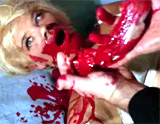
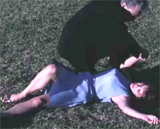
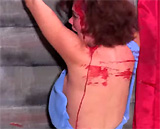
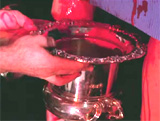
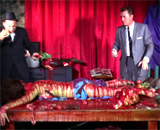
Lewis, dubbed "the godfather of gore," made a career out of similarly gory, low-budget drive-in films for the next decade (i.e., A Taste of Blood (1967), The Gruesome Twosome (1967), Something Weird (1967), The Wizard of Gore (1970) and The Gore Gore Girls (1972)). A sequel came much later: Blood Feast 2: All U Can Eat (2002). The film followed the infamous sacrificial intentions of a psychopathically-mad, homicidal, exotic food caterer named Fuad Ramses (Mal Arnold) who was murdering female victims in suburban Miami, FL in order to supplement his Exotic Catering service with meals composed of their organs and body parts. His ultimate objective was based upon his devotion to the dormant Egyptian goddess Ishtar ("The Mother of the Veiled Darkness"), to provide her with a ritualistic Egyptian blood feast in order to resurrect her. In the opening pre-titles murder scene, a blonde female named Pat Tracy (Sandra Sinclair) was hacked and mutilated to death by a crazed, grayish-haired, knife-wielding, wild-eyed maniac. She was struck in the eye, then whacked by a machete blade multiple times into her body and left knee before the killer stuffed some of her bloody remains (including her heart) into a bag. The letters in the film's title dripped reddish blood. The Miami Homicide Bureau's Police Captain Frank (Scott H. Hall) had assigned Detective Pete Thornton (William Kerwin) to investigate the rampaging serial killer who had committed seven killings (and mutilations) in two weeks without leaving any clues - the murders ("each killing more brutal than the other") had been reported on the radio (voice of Herschell Gordon Lewis, the director) in the last few days. There was a distinctive pattern left by each corpse - certain organs and body parts were removed from each victim. A newspaper headline described the murder: "LEGS CUT OFF!" Meanwhile, at Fuad Ramses Exotic Catering services, wealthy socialite Dorothy Fremont (Lyn Bolton) hired catering for her daughter Suzette Fremont's (Connie Mason) upcoming party in two weeks on a Saturday night. It was arranged for the "unusual" occasion to feature a rare Egyptian feast unoffered for 5,000 years by a Pharaoh. Unbeknowst to the Fremonts, Ramses was preparing a special 6:30 pm dinner - a 'blood feast' in honor of a large golden statue of Egyptian goddess Ishtar, that he worshipped in the back of his store. The contents of a large vat (with various female body parts) would be served to facilitate the resurrection of the goddess. Soon, there were four more murders - all revealing the same clues: the removal of one part of the body, and the victims were members of a book club, reading the book "Ancient Weird Religious Rites" written by Fuad Ramses:
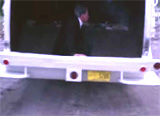
Suzette and her boyfriend Pete Thornton, the police detective involved in the investigation, were both attending a weekly lecture-class in Egyptian history and culture, where the lecturer Dr. Flanders (Al Golden) described the "Cult of Ishtar" that existed for 400 years until it was abolished. It involved a "bloodthirsty" devil-cult ritual after 7 days in which virginal priestesses laid on the altar of the temple were violently sacrificed to the evil Egyptian goddess Ishtar as a 'blood feast' offering to her. Pete surmised that all of the various clues in the murders pointed to Fuad Ramses as the homicidal killer, and found bloody remnants of Fuad's preparation for the feast of Ishtar in his back room, but he was unable to communicate his suspicions to Suzette in time. The dinner party at her home was already in session, where Fuad had cut the phone lines. Before the 'blood feast,' Suzette was summoned into the kitchen by Fuad to recline on the kitchen counter - an altar of sorts - and repeat a prayer to Ishtar ("O Ishtar, take me unto yourself") before he decapitated her with a machete. Suzette's mother Dorothy walked in and prevented Fuad from killing her daughter, as the police arrived (with Pete). Dorothy exclaimed humorously: "I guess we'll have to eat hamburgers for dinner tonight." The psychopath was chased into a nearby garbage dump. As Fuad attempted to climb into the back of a garbage truck to hide and be driven away, he was crushed and mangled to death by its sharp blades.
Captain Frank provided his assessment of the fiendish Fuad:
Pete also added: "Who knows if the spell of this monstrous goddess has possessed anyone else? Lust, murder, food for an ancient goddess who received life through the perverted death of others. Let's go home, Frank." The film's final image was of Fuad's golden statue of Ishtar crying bloody tears. |
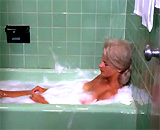
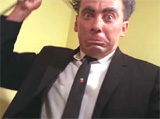 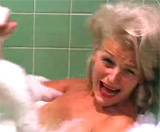 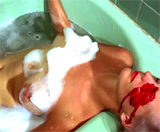 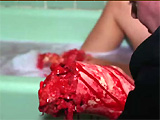 Pre-Title Credits Murder Sequence of Pat Tracy 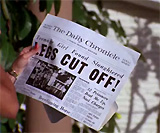 Headline About Teenage Girl's Murder: "Legs Cut Off!" 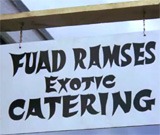 Catering Business Sign 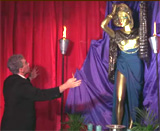  Fuad's Golden Statue of the Goddess Ishtar 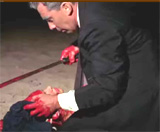 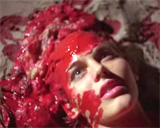 Murder of Marcy on Beach 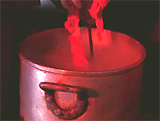 Body Parts of Victims Mixed in Large Pot 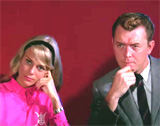 Suzette with Pete at Egyptian Lecture 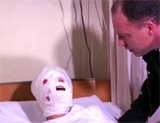 Dying Janet Blake in Hospital 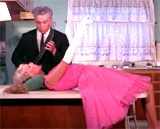  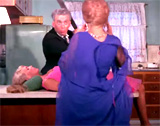 Preparations for Blood Feast (Machete Beheading of Suzette) Interrupted in Kitchen 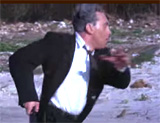 Fuad's Flight into Garbage Dump  The Film's Final Image: Bloody Tears From the Goddess Ishtar |
||||||||||||||||||
|
Bonnie And Clyde (1967)
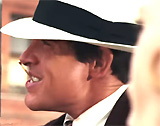
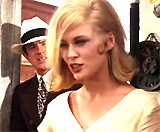
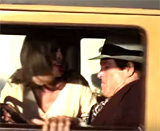
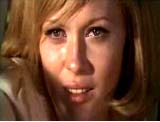
It was one of the sixties' most talked-about, volatile, controversial crime/gangster films combining comedy, terror, love, and ferocious violence. It was produced by Warner Bros. - the studio responsible for the gangster films of the 1930s. This innovative, revisionist Hollywood film redefined and romanticized the crime/gangster genre and the depiction of screen violence forever. The landmark film by post-WWII director Arthur Penn (who had previously directed The Miracle Worker (1962), The Train (1964) (uncredited and replaced by John Frankenheimer), and Mickey One (1965) - also with Beatty) was ultimately a popular and commercial success, but it was first widely denounced and condemned by film reviewers for glamorizing the two Depression-era killers (Bonnie Parker and Clyde Barrow), and only had mediocre box-office results. The Dust-Bowl period was effectively evoked, although the loose adaptation was also an inaccurate and fictionalized retelling of history. In the autumn of 1967, the film opened and closed quite quickly - enough time for it to be indignantly criticized for its shocking violence, graphic bullet-ridden finale (with its slow-motion ballet of death) and for its blending of humorous farce with brutal killings. Then, after a period of reassessment, there were glowing reviews, critical acclaim, a Time Magazine cover story, and the film's re-release - and it was nominated for ten Academy Awards. The film's overall impact was heightened by its open examination of the gallant Clyde's sexuality-impotence and the link to his gun-toting violence. The film was also remarkable and controversial for its honest depiction of the unique relationship between an impotent Clyde and the sexually-aggressive Bonnie. [Note: To fulfill heartthrob Warren Beatty's image as a sex-symbol, he was finally able to consummate his love for Bonnie by film's end.] When they first met, the real Bonnie (19 years old) and Clyde (21 years old) weren't glamorous characters, and their romantic involvement was questionable. She was already the wife of an imprisoned murderer, and he was a petty thief and vagrant with numerous misdemeanors. The film's opening presented a colorful closeup of red, luscious lips (that were being licked after lipstick had been applied) belonging to blonde Bonnie Parker (Faye Dunaway) - a bored, beautiful, and sexually-frustrated, Depression-era Texas cafe waitress who was naked and narcissistically primping in front of a mirror; her teasing and nude appearance at her bedroom window occurred as small-town con and car thief Clyde Barrow (Warren Beatty) eyed her Mama's car out front; she quickly dressed and descended the stairs to join him. Bank-robbing Clyde's first major seduction of Bonnie came when he showed off his gun and bounced a wooden matchstick between his teeth (shot at an upward angle as a trembling phallic symbol), although he was later revealed to be impotent (he later told her: "I might as well tell ya right off. I ain't much of a lover boy. But that don't mean nothin' personal about you. I-I-I never saw no percentage in it. Ain't nothin' wrong with me. I don't like boys"). After proving himself by robbing the grocery store across the street, they were formally introduced to each other as they jumped in a getaway car together: Bonnie: "Hey, what's your name anyhow?" Clyde: "Clyde Barrow" Bonnie: "Hi, I'm Bonnie Parker, pleased to meet ya."
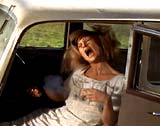
In the film, the story of Clyde's rise and self-destructive fall as an anti-authoritarian criminal gangster was clearly depicted. Both tragic outlaw figures exemplified 'innocents on the run' who clung to each other and tried to function as a family. The film, with many opposing moods and shifts in tone (from serious to comical), was a cross between a gangster film, tragic-romantic traditions, a road film and buddy film, and screwball comedy. In a deserted, bank-foreclosed farmhouse, Bonnie was jubilantly hugged by Clyde after exhibiting her gun-shooting prowess at an old rubber-tire-swing target; their shooting attracted the attention of bank-displaced, evicted farmer Otis Harris and his family, who they sympathized with; Clyde boasted: "This here's Miss Bonnie Parker. I'm Clyde Barrow...We rob banks." Clyde ultimately consummated his love for Bonnie, when she assured him: "You did just perfect," after which he complimented himself while chuckling: "I did, didn't I? I mean, I really did. I never figured on that. Damn"; in their next bedroom scene, they discussed their relationship, although they were soon doomed to die: Bonnie: "Clyde. Why do you want to marry me?" Clyde: "To make an honest woman out of you." There was a quick montage - a succession of events - during the country backwoods, roadside ambush sequence conducted by police. The duo had been betrayed by father Ivan (or Malcolm) Moss (Dub Taylor), who flagged down their car for help while faking a flat tire on his truck by the side of the road; he spoke the last lines of the film: "I've got a flat tire, and I ain't got no spare." In their final freeze-frame of life in a two-minute violent "ballet of blood", doomed lovers Bonnie and Clyde revealed both panic and love in their faces - with a silent glance toward each other; their frenzied, spasming corpses writhed in slow-motion as they were gunned down and riddled with an unprecedented number of bullets; they were re-animated by gunfire - into involuntary dances of death when their corpses twitched to life; they died cinematically-beautiful, abstracted deaths to accentuate the romance of the myths and the larger-than-life legends that surrounded them; their last moment of 'life' occurred when Clyde rolled over gently in slow-motion and Bonnie's arm dangled unnaturally and then stopped moving; Bonnie's flowing blonde hair, streaked in sunlight and gently blowing in the breeze, cascaded down in many arcs as she hung out of the car
The last fractured image was viewed as the group of police approached the bullet-ridden car and the corpses on the ground (off-screen); the final shot was a shattered car window from a bullet hole - before a rapid cut to black. |
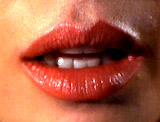 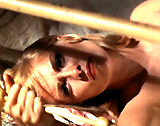 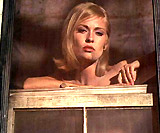 Bonnie Parker's Sexy Introduction 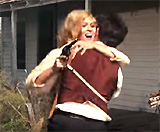 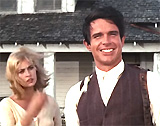 Clyde: "We rob banks!" 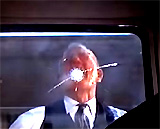 Bullet Damage During One Botched Robbery 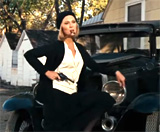 Picture-Taking 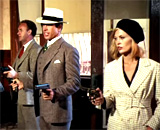 "Good Afternoon, This is the Barrow Gang!" 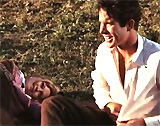 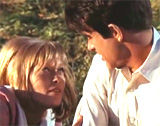 After-Sex: "You did just perfect" 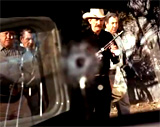 The Final Image |
||||||||||||||||||
|
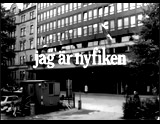
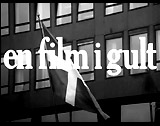
I Am Curious (Yellow)
(1967, Swe.) (aka Jag är Nyfiken - En Film I Gult)
This landmark, avante-garde, mock-documentary film (shot with mostly hand-held cameras) allegedly included 'offensive' sexual scenes that were claimed to be pornographic at the time - scenes of full frontal nudity of both sexes (at 38 minutes into the film), simulated intercourse, and the kissing of the male's flaccid penis (over a full hour into the film) including stroking of pubic hair. US Customs seized the film in 1968, and the courts (and the Supreme Court) originally determined that the movie was 'obscene', although this verdict was overturned after appeal. Many Supreme Court battles ensued before it could be distributed. It became a benchmark film for free-speech advocates. After it was cleared and released in the US in 1969, it became a blockbuster hit, although it was often picketed. It garnered $5 million in six months (a much higher figure when adjusted for inflation). The Swedish import soon became the highest-grossing foreign film (at $20 million) released in the US for decades (a record that stood until Il Postino broke the mark in the mid 1990's), although most who watched it considered it boring and pretentious. By today's standards, it is considered tame, but it helped to open the floodgates toward hard-core pornography that exhibited penetration and ejaculation, such as the X-rated Best Picture Midnight Cowboy (1969), the porno chic Deep Throat (1972), and Bernardo Bertolucci's Last Tango in Paris (1972).
The radical, experimental film-within-a-film of sexual politics told the dull and pretentious story of liberated 22 year-old Lena (Lena Nyman), an aspiring sociologist who was curious about political issues in late 60s Sweden, with endless soul-searching, lengthy street interviews with common people about the class system, newsreel footage, scenes of protest regarding the Vietnam War, scribbled on-screen slogans, her cataloguing of information, etc. Sexual interludes between Lena and car salesman Borje (mirrored in the film and real life by a tumultuous triangle with director Vilgot Sjoman) are shot frankly and realistically. Unused footage and alternate takes from the film were culled for a concurrent, parallel film I Am Curious (Blue) (1968, Swe.) released in the US in 1970. The choice of colors represented the two colors of the Swedish flag. |
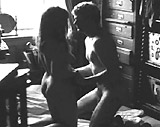  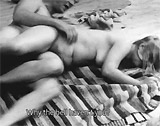 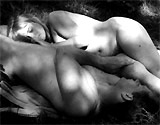 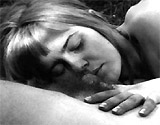 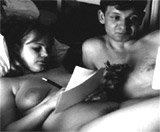  Controversial Sexual Scenes Between Lena and Borje |
||||||||||||||||||

|
Titicut Follies (1967)
First-time filmmaker Frederick Wiseman's despairing cinema-verite (observational or objective) masterpiece, one of the greatest documentaries of all time, was about the horrid and abusive conditions ("painful aspects of mental disease") at the state-run Massachusetts Correctional Institution in Bridgewater, a prison-hospital asylum for seriously ill, heavily-tranquilized men (defined by authorities as "criminally insane" or "sexually dangerous"). The film's title referred to a mock-softshoe song/dance routine ("Strike Up the Band"), performed and acted out at the beginning and end of the film by the inmates and prison officers during an annual vaudeville/variety show (the 'Titicut Follies') performance at the institution. This highly controversial film (filmed in 1966 on black and white 16 mm. film over a period of 29 days) was barred from distribution and withdrawn from circulation from 1967-1992, by legal action launched by state authorities, because it was considered a violation of the rights of privacy of the prison inmates it filmed, and because it was considered obscene (the film showed male frontal nudity). It was only shown at the New York Film Festival in 1967, and had two limited runs in New York -- aside from a few screenings before film societies.
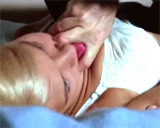
The silent and passive camera witnessed the stripping, dehumanizing and humiliation of mental patients (who were treated like wild animals) by bullying guards, wardens and psychiatrists. One inmate, who was starving himself to death as protest, was force-fed through a rubber tube roughly inserted into his nostril - followed shortly by the image of his face as he laid in a coffin while being prepared for his funeral. |
 Scene of Horrid Conditions in Prison-Hospital Asylum 
Rubber-Tube Insertion into Nostrils |
||||||||||||||||||
 The
100+ Most Controversial Films of All-Time The
100+ Most Controversial Films of All-Time(chronologically, by film title) Intro | Silents-1930s | 1940s-1950s | 1960-1961 | 1962-1967 | 1968-1969 1970-1971 | 1972 | 1973-1974 | 1975 | 1976-1977 | 1978 | 1979 1980-1982 | 1983-1986 | 1987-1989 | 1990-1992 | 1993-1995 | 1996-1999 2000-2002 | 2003-2005 | 2006-2009 | 2010-present |




 Stanley
Kubrick played up the dark humor in Nabokov's novel about a middle-aged
man infatuated with a pubescent girl, but the subject was still
a shocker.
Stanley
Kubrick played up the dark humor in Nabokov's novel about a middle-aged
man infatuated with a pubescent girl, but the subject was still
a shocker.