|
1961
The winner is listed first, in CAPITAL letters.
Filmsite's Greatest Films
of 1961
Actor:
MAXIMILIAN SCHELL in "Judgment at Nuremberg", Charles
Boyer in "Fanny", Paul Newman in "The
Hustler", Spencer Tracy in "Judgment at Nuremberg",
Stuart Whitman in "The Mark"
Actress:
SOPHIA LOREN in "Two Women", Audrey Hepburn in "Breakfast
at Tiffany's", Piper Laurie in "The
Hustler", Geraldine Page in "Summer and Smoke",
Natalie Wood in "Splendor in the Grass"
Supporting Actor:
GEORGE CHAKIRIS in "West
Side Story", Montgomery Clift in "Judgment at Nuremberg",
Peter Falk in "Pocketful of Miracles", Jackie Gleason
in "The Hustler", George C.
Scott in "The Hustler"
Supporting Actress:
RITA MORENO in "West
Side Story", Fay Bainter in "The Children's Hour",
Judy Garland in "Judgment at Nuremberg", Lotte Lenya
in "The Roman Spring of Mrs. Stone", Una Merkel in "Summer
and Smoke"
Director:
JEROME ROBBINS and ROBERT WISE for "West
Side Story", Federico Fellini for "La Dolce Vita",
Stanley Kramer for "Judgment at Nuremberg", J. Lee
Thompson for "The Guns of Navarone", Robert Rossen
for "The Hustler"
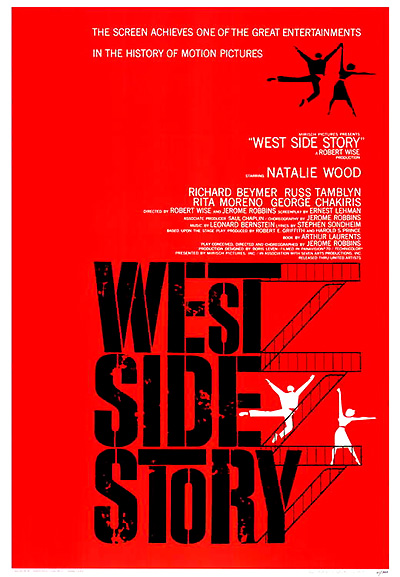 The
Best Picture winner was a well-honored musical with Leonard
Bernstein's score, fiery dance numbers and Stephen Sondheim's
lyrics in a contemporary updating of Shakespeare's story of Romeo
and Juliet (with rival NY street gangs - Puerto-Rican Sharks
headed by George Chakiris and Jets led by Richard Beymer) titled West
Side Story. The film had eleven nominations and ten
Oscar wins (losing only its Screenplay nomination) - close
to matching the record established by Ben-Hur
(1959) with its twelve nominations and eleven Oscars. The
Best Picture winner was a well-honored musical with Leonard
Bernstein's score, fiery dance numbers and Stephen Sondheim's
lyrics in a contemporary updating of Shakespeare's story of Romeo
and Juliet (with rival NY street gangs - Puerto-Rican Sharks
headed by George Chakiris and Jets led by Richard Beymer) titled West
Side Story. The film had eleven nominations and ten
Oscar wins (losing only its Screenplay nomination) - close
to matching the record established by Ben-Hur
(1959) with its twelve nominations and eleven Oscars.
The Best Picture winner's awards included: Best
Picture, Best Supporting Actor, Best Supporting Actress, Best
Director (Robert Wise and co-credited choreographer Jerome
Robbins), Best Art Direction, Best Cinematography, Best Sound,
Best Musical Score, Best Film Editing, and Best Costume Design.
Only two of its ten Oscars went to actors (in supporting roles).
Robbins was also awarded a special statuette for "his
brilliant achievements in the art of choreography on film." Robbins
was the only Best Director Oscar winner to win for the only
film he ever directed.
[West
Side Story was the first instance in which a
co-directing team - Robbins and Wise - won the Best Director
Oscar. Joel
and Ethan Coen also won the Best Director Oscar for No Country For
Old Men (2007). Other examples of a directorial team being
nominated were Heaven Can Wait (1978) with co-directors
Warren Beatty and Buck Henry, and the Coen brothers nominated for True
Grit (2010).]
The other nominees for Best Picture included
the following:
- director Joshua Logan's non-musical Fanny (with
five nominations and no wins) with Leslie Caron and Maurice
Chevalier (co-stars in the successful Gigi (1958))
cast in the title roles as a young girl who finds herself
pregnant and her husband - a different older man
- director J. Lee Thompson's suspenseful action/adventure
war film, The Guns of Navarone (with seven nominations
and only one win - Best Special Effects) about a sabotage
team of American-British-Greek intelligence agents sent in
1943 to the fictionalized Aegean island of Navarone to destroy
giant German guns
- director Robert Rossen's character drama about
professional pool-room sharks and a naive, self-destructive
pool hustler, The Hustler (with
nine nominations and two wins - Best B/W Cinematography and
Best B/W Art Direction/Set Decoration)
- director Stanley Kramer's three-hour long,
star-studded Judgment At Nuremberg (with eight nominations
and two wins - Best Actor and Best Screenplay) - a film about
the 1948 war crimes trials following World War II
The Hustler accumulated
four acting nominations, but none of the deserving individuals
won.
- Paul Newman (with his second nomination)
probably gave the greatest performance of his career and
was nominated as Best Actor for his role as professional
pool shark Fast Eddie Felson. [Newman would have to wait
25 years to win an Oscar for playing the same character -
only older - in the sequel The Color of Money (1986).]
- co-star Piper Laurie (with her first of three
career nominations) was nominated for Best Actress as Sarah
Packard, Paul Newman's crippled, alcoholic girlfriend/lover
- Two Best Supporting Actor nominees in The
Hustler were:
- Jackie Gleason (with his sole nomination)
as real-life hustler Minnesota Fats
- George C. Scott (with his second of
four career nominations) in a superb performance as
Bert Gordon - Felson's fast-talking, conniving, manipulative
promoter/manager [Note: Actor George C. Scott in his
third screen appearance became the first actor to decline
an Oscar nomination (to be awarded in 1962). Though
he wished to turn down the nomination, his name remained
on the ballot, and he lost to George Chakiris for West
Side Story (1961).]
Three of the four performers who won acting Oscars
were virtually unknown - Maximilian Schell, George Chakiris,
and Rita Moreno, and the fourth, Sophia Loren, was known mostly
as an Italian sexpot rather than as a serious, deglamourized
actress. The winning group basically beat out lots of better
known heavyweights.
The Best Actor winner was 31 year-old Austrian-born
Maximilian Schell (with the first of three career nominations
- and his sole Oscar win) as Hans Rolfe - a disturbing
Nazi-German defense lawyer who defended the Nazi generals for
war crimes in Judgment at Nuremberg. [Note: Schell's role
was basically a supportive one, and he was listed fourth in
the cast. He became the first performer to win an Academy Award
for recreating on screen a role he had originally performed
for television.] He was the only performer to take home the
film's sole acting Oscar win.
Other Best Actor nominees included:
- Schell's co-star Spencer Tracy (with his eighth
and next-to-last career nomination) as Judge Dan Haywood
- the presiding American/Allied judge in the Nuremberg trials
in Judgment at Nuremberg
- Charles Boyer (with his fourth and
last unsuccessful career nomination) as waterfront proprietor
Cesar (Horst Buchholz's father), in Fanny
- Stuart Whitman (with his sole nomination)
as Jim Fuller - a paroled child molester in the dramatic
British film by director Guy Green, The Mark (the
film's sole nomination)
- Paul Newman (see above)
The Best Actress award also went to a non-American,
to help acknowledge non-English language performers and boost
Hollywood's desire to favor non-American markets for films:
- Sophia Loren (with her first of two
career nominations) won her only Oscar in director
Vittorio De Sica's sub-titled Italian film Two Women (1960, It.)
(aka La Ciociara) (the film's sole nomination) in the
role of Cesira - the widowed and tormented young mother of
a 13-year-old daughter (Eleanora Brown) who she vainly tried
to protect in war-torn Italy during World War II. In the
Italian countryside during the taking of Rome, both of them
were traumatized and forced to survive an aerial strafing
attack, deprivation, and rape during the dark war year of
1943. [Note: The film's sole nomination won Best Actress
for Loren. This same feat occurred when Jodie Foster won
Best Actress for The Accused (1988) - also the film's sole
nomination.]
[Note: Loren was the first to be nominated for
(and win) an acting Oscar for a foreign-language film role
- in a film that was not in English. This feat, a non-English
acting award, was also awarded to Roberto Benigni for his performance
in Life is Beautiful (1998). Also, Loren remains the only actress
to win an Oscar in a foreign-language film. However, it has
been noted that Robert De Niro also won an Oscar for his foreign-language performance,
speaking only Italian/Sicilian in The
Godfather, Part II (1974), and the same is true of
Meryl Streep's Best Actress foreign-language performance in Sophie's
Choice (1981), and Haing S. Ngor's Best Supporting Actor
role in The Killing Fields (1985).]
Sophia Loren's other competitors in the Best
Actress race included:
- Audrey Hepburn (with her fourth of five career
nominations) in one of her best-loved roles as charming,
eccentric, melancholy New York City playgirl Holly Golightly
in director Blake Edwards' offbeat romance, Breakfast
at Tiffany's (with five nominations and two wins - Best
Comedy Score, and Best Song for Hepburn's rendition of Henry
Mancini's "Moon River")
- Geraldine Page (with her second of eight career
nominations) as Alma Winemiller - a repressed Mississippi
minister's daughter/spinster in another adaptation of a Tennessee
Williams play by director Peter Glenville, Summer and
Smoke (with four nominations and no wins)
- Natalie Wood was nominated (with her second
of three unsuccessful career nominations) for her role as
teen sweetheart and sexually-frustrated, troubled teenager
Wilma Dean ("Deanie") Loomis opposite boyfriend
Warren Beatty (in his film debut) in director Elia Kazan's Splendor
in the Grass (with two nominations and one win -
Best Story and Screenplay)
- Piper Laurie (see above)
The two Best Supporting Actor and Actress awards
went to two West
Side Story co-stars:
- Puerto-Rican-born Rita Moreno (with her sole
nomination and Oscar win in her entire career) as the fiery,
headstrong, tempestuous, skirt-tossing dancer, a Puerto Rican
'Sharks' member, and Maria's (Natalie Wood) friend Anita.
She was the first Hispanic actress to win an acting
Academy Award. She was also the second performer
(after Helen Hayes) to win these four different awards -
Oscar (1961), Tony (1975), Emmy (1977, 1978), and Grammy
(1972) - by 1977, one year after Hayes.
- George Chakiris (with his sole nomination
- and sole Oscar win - in his first leading film role) as
the 'Sharks' tragic, knife-fighting gang leader Bernardo,
the heroic brother of the film's Juliet - Maria (Natalie
Wood)
At the time, front-runner favorites were two
Supporting Actor/Actress nominees for their roles in Judgment
at Nuremberg - Montgomery Clift and Judy Garland - and
both of them had never won Oscars. The Best Supporting
Actor nominees who lost were:
- Montgomery Clift (with his fourth and last
unsuccessful career nomination) was nominated as Rudolf Petersen
- a Nazi-victimized witness who testifies for the prosecution,
in Judgment at Nuremberg
- Peter Falk (with his second consecutive and
last career nomination) as Joy Boy in Frank Capra's remake
of his own Lady for a Day (1933) (and Capra's last
film), Pocketful of Miracles (with three nominations
and no wins) - the film co-starred Bette Davis as down-and-out
street vendor Apple Annie
- Jackie Gleason (see above)
- George C. Scott (see above)
Other losing Best Supporting Actress nominees
included:
- Judy Garland (with her second and last unsuccessful
career nomination) as Irene Hoffman - a German housewife
who defends her marriage to a Jew, in Judgment at
Nuremberg
- Fay Bainter (with her third and last career
nomination in her last film) in the role of Mrs. Amelia Tilford
- the grandmother of a lying teenage girl in director William
Wyler's film version of Lillian Hellman's play about slander
directed toward two teachers in a re-make of Wyler's own These
Three (1936) titled The Children's Hour (with
five nominations and no wins)
- Lotte Lenya (with her sole nomination) as
unappealing, Italian procuress Contessa Magda Terribili-Gonzales
in director Jose Quintero's film of an adaptation of a Tennessee
Williams novella, The Roman Spring of Mrs. Stone (the
film's sole nomination) - a film starring Vivien Leigh as
a fading, widowed actress in Rome and Warren Beatty as a
handsome Italian gigolo
- Una Merkel (with her sole nomination), a veteran
character actress for many decades, was also nominated as
Geraldine Page's mentally-disturbed mother Mrs. Winemiller.
(Merkel lost her sole Oscar bid to another Summer
and Smoke co-star, Rita Moreno who won for her role in
a different film)
Oscar Snubs and Omissions:
Although Breakfast at Tiffany's was nominated
five times, and won two Oscars (Best Score and Best Song for
Henry Mancini), it was not nominated for Best Picture.
Producer/director Elia Kazan's Splendor
in the Grass, nominated for only two Oscars (an
unsuccessful Best Actress nomination for Natalie Wood and
a Best Original Story and Screenplay nomination with Oscar
awarded to William Inge), failed to achieve a Best Picture
or Best Director nomination. In the same year, Natalie
Wood starred in West
Side Story as Puerto Rican Maria, one of the star-crossed
romantic lovers (with singing dubbed by Marni Nixon), but
was un-nominated for that role.
Oscar-worthy nominees for acting roles in many
overlooked films included James Cagney in his second-to-last
film as European Coca-Cola executive C.R. MacNamara, and Hanns
Lothar with his comedic, heel-clicking performance as Schlemmer
- in Billy Wilder's satirical farce One, Two, Three (with
one unsuccessful nomination for B/W Cinematography). Also overlooked
was the young and promising Albert Finney for his role as hedonistic
working-class Arthur Seaton in the British film Saturday
Night and Sunday Morning (un-nominated for any awards),
Vincent Price as the villainous Nicholas Medina in the second
of Roger Corman's Edgar Allan Poe series - The Pit and the
Pendulum, Sidney Poitier for his performance as Walter
Lee Younger - part of a financially struggling Chicago black
family in A Raisin in the Sun (also un-nominated for
any awards), and Rosalind Russell for her performance as widowed
Brooklynite Mrs. Jacoby, a stereotypical Jewish mother in A
Majority of One.
Vivien Leigh was un-nominated for her performance
as a wealthy, widowed actress living in Rome - attractive to
gigolo Warren Beatty in The Roman Spring of Mrs. Stone,
and young Hayley Mills' role as an innocent Kathy Bostock in
director Bryan Forbes' allegorical Whistle Down the Wind (un-nominated
for any awards) was also un-nominated. And the last film of
legends Marilyn Monroe and Clark Gable, director John Huston's The
Misfits, received no nominations.
Through a Glass Darkly (Sw.) brought Ingmar
Bergman his second Best Foreign Film Oscar win, but was missing
from the Best Picture nominees.
Although Federico Fellini's La Dolce Vita had
a total of four nominations (including two for Fellini himself
for his direction and screenplay, another nomination for Best
Art Direction, and an Oscar win for its Best Costume Design),
Marcello Mastroianni was not nominated for his famed role as
handsome, world-weary, desperate gossip columnist Marcello
Rubini. [Later in his career, Mastroianni was nominated three
teams for leading roles in Divorce - Italian Style (1962), A
Special Day (1977), and Dark Eyes (1987).] His co-star
Anita Ekberg was also not nominated for her role as buxom movie
star Sylvia, who cavorted and danced in Trevi's water fountain
in a black evening gown. Her entire career was unrecognized
by the Academy. |