  1943 Academy Awards® Winners and History |
Introduction, 1927/8-39, 1940s, 1950s, 1960s, 1970s, 1980s, 1990s, 2000s, 2010s, 2020s Academy Awards Summaries |
"Best Picture" Oscar®, "Best Director" Oscar®, "Best Actor" Oscar®, "Best Supporting Actor" Oscar®, "Best Actress" Oscar®, "Best Supporting Actress" Oscar®, "Best Screenplay/Writer" Oscar® |

1943
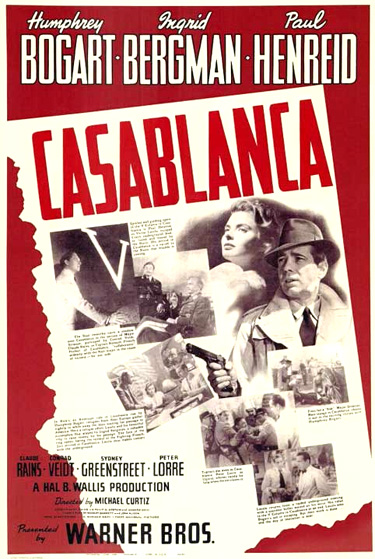
Actor: Director Michael Curtiz' Casablanca (with eight nominations and three Oscar wins - Best Picture, Best Director, and Best Screenplay for Julius J. Epstein, Philip G. Epstein and Howard Koch) - the melodramatic story of international intrigue, romance and politics in the Nazi-occupied exotic locale of French Morocco, is now considered one of filmdom's best pictures ever made. The classic masterpiece of sacrifice and comradeship deservedly won the Best Picture award for 1943, but it was a dark horse candidate. Actually, it should have competed against Mrs. Miniver (1942) (the Best Picture winner in the previous year), since it premiered in New York in November of that year. However, it didn't show in Los Angeles until its general release that January, so it competed in 1943. With an inspired cast, As Time Goes By, a great director, and unexpected wartime publicity, the superior film told the story of an aloof American owner (Bogart) of a bar in Casablanca who rescues his old girlfriend (Bergman) and her Resistance husband (Henreid) from the clutches of Axis authorities. During WWII's height, four of the Best Picture nominees in 1943 had war as their themes. In addition to the Best Picture winner, three of the other nine Best Picture nominees of 1943 were also war films with patriotic or sentimental themes:
Hungarian-born Paul Lukas (with his sole career nomination) won the Best Actor award - his first and only Oscar - for his role as Kurt Muller, a German engineer and anti-Nazi underground Resistance leader who flees the Nazis with wife Bette Davis to seek refuge in the US (Washington) and continue his freedom-fighting activities - until he is blackmailed - in Watch on the Rhine. Unfortunately, Humphrey Bogart (with his first of three career nominations), in his quintessential, signature role as disaffected cafe owner Rick Blaine in Casablanca lost the Oscar, but his nomination brought him recognition and status as a top actor. The other three Best Actor nominees were:
In the Best Actress race, this was the first time in six years that Bette Davis didn't receive an Oscar nomination. She had been nominated as Best Actress for six consecutive years (from 1938-1942), and had won in both 1935 and 1938. The Best Actress winner was twenty-four year-old Jennifer Jones (with her first career nomination) as the 14 year-old, 19th century French peasant girl of Lourdes named Bernadette in an adaptation of Franz Werfel's novel The Song of Bernadette. Jones portrayed a young, saintly girl who became canonized after claiming to have seen a vision of the Virgin Mary (played by Linda Darnell, Darryl Zanuck's mistress) while gathering firewood, and was inspired to dig a well at the spot. [Producer/director David O. Selznick's protege (and future wife in 1949) was, in all respects, appearing in her debut film, although she had been in a few minor low-budget pictures a few years earlier under her real name - Phyllis Isley. Jennifer Jones never won another Oscar, but she was nominated four more times in the films: Since You Went Away (1944), Love Letters (1945), Duel in the Sun (1946), and Love is a Many Splendored Thing (1955).] The Best Actress win for Jennifer Jones also deprived other great actresses of awards:
In the Best Supporting Actor race, Charles Coburn (with his second nomination and sole Oscar win) won the Oscar for his role as Benjamin Dingle - an old, daffy gentleman who is a rich philanthropist/matchmaker sharing a room for rent in an apartment with Jean Arthur and Joel McCrea in the overcrowded, wartime US capital during wartime in The More the Merrier. The other four nominees were:
Greek actress Katina Paxinou (in her first American film and with her first and sole nomination) won the Best Supporting Actress award - her first and only Oscar - for her role as the powerful and fiery hill woman and gypsy Spanish Civil War revolutionary Pilar (Akim Tamiroff's wife in the film) who is a member of a loyalist band helped by Gary Cooper in For Whom the Bell Tolls. Paxinou's victory defeated two co-stars of The Song of Bernadette:
The remaining two nominees in the Best Supporting Actress category were:
Max Steiner's score for the Best Picture winner, including the immortal song: "As Time Goes By," lost to Alfred Newman's Score for The Song of Bernadette. Arthur Edeson's Oscar-nominated B/W Cinematography for Casablanca was defeated by Arthur Miller for The Song of Bernadette. Oscar Snubs and Omissions: Although The More the Merrier had received nominations for Best Picture, Best Actress, Best Director (George Stevens), Best Original Story and Screenplay, and a win for Best Supporting Actor, Joel McCrea was deprived of an Oscar nomination for his crucial comic role in the film. In fact, McCrea never received an Oscar nomination. Ironically, Ingrid Bergman was nominated (and lost) for For Whom the Bell Tolls as Gary Cooper's lover, but was un-nominated for her most famous role as beautiful and radiant Ilsa Lund, co-star Humphrey Bogart's conflicted Parisian love interest - who asked cafe pianist Sam to play "As Time Goes By," in the most famous scene in Michael Curtiz's Casablanca. Also un-nominated was Ida Lupino's great performance in The Hard Way - the role won her the Best Actress award from the New York Film Critics. Likewise, the great silent film director Erich von Stroheim was omitted from the nominees for his role as Erwin Rommel in Billy Wilder's second film, Five Graves to Cairo. [Stroheim would have to wait seven years for his first nomination -- for his unforgettable role as Max von Mayerling in Sunset Boulevard (1950).] The Best Picture-nominated film The Ox-Bow Incident was a deserved honor, but none of the cast, including Henry Fonda, was nominated. Ernst Lubitsch's nomination for Best Director for the Best Picture nominee Heaven Can Wait was doomed to lose. Actor Don Ameche turned in one of his best performances in the film and it was one of Lubitsch's greatest, but 20th Century-Fox was promoting The Song of Bernadette instead. One of Hitchcock's greatest thrillers (and the director's own favorite), Shadow of a Doubt, deserved more recognition than it received - only a Best Original Screenplay nomination - snubbed were both Joseph Cotten's chilling role as dark-hearted, widow-murdering serial killer Uncle Charlie, and Teresa Wright's performance as Young Charlie (Charlie's niece). [Joseph Cotten never received an Oscar nomination, although he appeared in some of the greatest films ever made, including Citizen Kane (1941) and The Magnificent Ambersons (1942).] Elizabeth Taylor's second film Lassie Come Home, the first feature film to star a collie, helped to launch her career and the beloved animal series that began in 1954 - it received only one nomination - for Color Cinematography. [Lassie Come Home was followed by six sequels.] The feature film that was the directing debut of Vincente Minnelli was Cabin in the Sky - it featured an all-black cast. The film's sole un-successful nomination was for Best Song, "Happiness is a Thing Called Joe." Other films without any nominations included Old Acquaintance (with Bette Davis and Miriam Hopkins) and one of Jacques Tourneur's best horror films with producer Val Lewton: I Walked With a Zombie. Hangmen Also Die received only two nominations (for Best Song and Score). |
|||||||||||||||







 This
was the first year that Best Supporting Actors and Actresses
received full-sized Oscar statuettes, rather than miniature
Oscar plaques.
This
was the first year that Best Supporting Actors and Actresses
received full-sized Oscar statuettes, rather than miniature
Oscar plaques.